


Page 327 - Applied Process Design for Chemical and Petrochemical Plants Volume I
P. 327
298                       Applied Process Design for Chemical and Petrochemical Plants


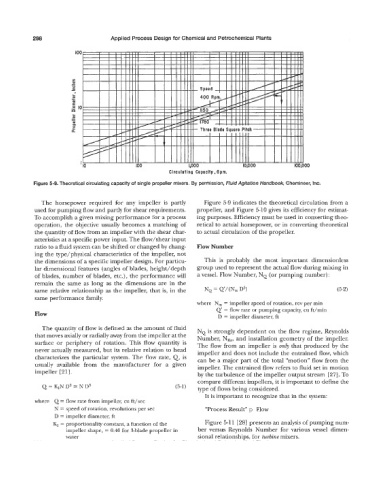
            Figure 5-9. Theoretical circulating capacity of single propeller mixers. By permission, Fluid Agitation Handbook, Chemineer, Inc.


               The  horsepower  required  for  any  impeller  is  partly   Figure 5-9 indicates the theoretical  circulation from a
            used for pumping flow and partly for shear requirements.   propeller, and Figure 5-10 gives its efficiency for estimat-
            To accomplish a given mixing performance for a process   ing purposes. Efficiency must be used in converting theo-
            operation, the  objective usually becomes a matching of   retical to actual horsepower, or in converting theoretical
             the quantity of flow from an impeller with the shear char-   to actual circulation of the propeller.
             acteristics at a specific power input. The flow/shear input
             ratio to a fluid system can be shifted or changed by chang-   Flow Number
             ing the type/physical characteristics of the impeller, not
             the dimensions of a specific impeller design. For particu-   This  is  probably  the  most  important  dimensionless
             lar dimensional features (angles of blades, height/depth   group used to represent the actual flow during mixing in
             of blades, number  of  blades, etc.), the performance will   a vessel. Flow Number, NQ (or pumping number) :
             remain  the  same as  long as  the  dimensions  are  in  the
             same relative relationship as the impeller, that is, in the
             same performance family.
                                                                  where  N,  = impeller speed of rotation, rev per min
                                                                         Q’  = flow rate or pumping capacity, cu ft/min
             Flow
                                                                         D = impeller diameter, ft
               The quantity of flow is defined as the amount of fluid   NQ is  strongly dependent on the flow regime, Reynolds
             that moves axially or radially away from the impeller at the   Number, NRe, and installation geometry of  the impeller.
             surface  or  periphery  of  rotation.  This  flow  quantity  is   The flow from an impeller is  on4 that produced by  the
             never actually measured, but its relative relation  to head   impeller and does not include the entrained flow, which
             characterizes the  particular  system. The flow rate,  Q, is   can be a major part of the total “motion” flow from the
             usually  available  from  the  manufacturer  for  a  given   impeller. The entrained flow refers to fluid set in motion
             impeller [21].                                       by the turbulence of the impeller output stream  [27]. To
                                                                  compare different impellers, it is important to define the
               Q = KIN D3 = N D3                           (5-1)   type of flows being considered.
                                                                     It is important to recognize that in the system:
             where  Q = flow rate from impeller, cu ft/sec
                   N = speed of rotation, revolutions per sec        “Process Result”  p  Flow
                   D = impeller diameter, ft
                   Kl  = proportionality constant, a function of the   Figure 5-1  1 [ 281 presents an analysis of pumping num-
                       impeller shape, = 0.40 for 3-blade propeller in   ber  versus  Reynolds Number  for  various vessel  dimen-
                       water                                      sional relationships, for turbine mixers.

