


Page 331 - Applied Process Design for Chemical and Petrochemical Plants Volume I
P. 331
302                       Applied Process Design for Chemical and Petrochemical Plants


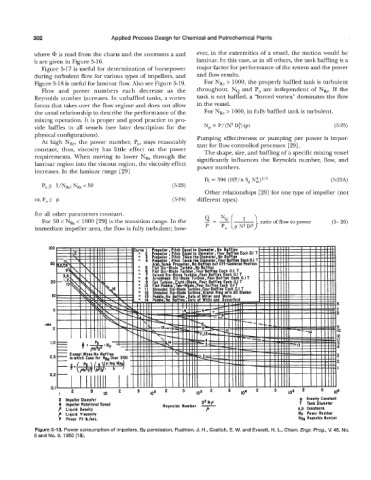
            where    is read from the charts and the constants a and   ever, in the extremities of a vessel, the motion would be
            b are given in Figure 5-16.                           laminar. In this case, as in all others, the tank baffling is a
               Figure 5-17 is useful for determination  of horsepower   major factor for performance of the system and the power
            during turbulent flow for various types of  impellers, and   and flow results.
            Figure 5-18 is useful for laminar flow. Also see Figure 5-19.   For NRe > 1000, the properly baffled tank is turbulent
               Flow  and  power  numbers  each  decrease  as  the   throughout.  NQ and Po are independent of  NR~. If  the
            Reynolds number increases. In unbaffled tanks, a vortex   tank is not baffled, a “forced vortex” dominates the flow
            forms that takes over the flow regime and does not allow   in the vessel.
             the usual relationship to describe the performance of the   For NRe > 1000, in fully baffled tank is turbulent.
             mixing operation. It is proper and good practice to pro-
            vide  baffles  in  all vessels  (see  later  description  for  the   N, = P/(N3 D?) (PI             (5-25)
             physical configurations).                            Pumping  effectiveness or pumping  per power is  impor-
               At  high  N,,   the  power  number,  Po,  stays  reasonably   tant for flow controlled processes [29].
             constant,  thus,  viscosity  has  little  effect  on  the  power   The shape, size, and baffling of a specific mixing vessel
             requirements.  When  moving  to  lower NRe through  the   significantly influences  the  Reynolds number, flow,  and
             laminar region into the viscous region, the viscosity effect   power numbers.
             increases. In the laminar range [29]
                                                                     Di = 394 (HP/n S,  Ni)1’5                (5-25A)

                                                                     Other relationships  [29] for one type of impeller  (not
                                                                  different types)


             for all other parameters constant.
               For 50 < NRe < 1000 [29] is the transition range. In the                ratio offlow to power   (5 - 26)
             immediate impeller area, the flow is fully turbulent; how-


             Figure 5-13. Power consumption of impellers. By permission, Rushton, J. H., Costich, E. W. and Everett, H. L., Chem. Engr. Prog., V.  46, No.
             8 and No. 9, 1950 [18].

