


Page 170 - Basics of MATLAB and Beyond
P. 170
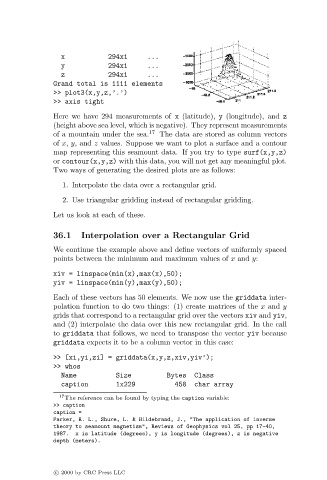
x            294x1     ...
                                 y            294x1     ...
                                 z            294x1     ...
                               Grand total is 1111 elements
                               >> plot3(x,y,z,’.’)
                               >> axis tight

                               Here we have 294 measurements of x (latitude), y (longitude), and z
                               (height above sea level, which is negative). They represent measurements
                               of a mountain under the sea. 17  The data are stored as column vectors
                               of x, y, and z values. Suppose we want to plot a surface and a contour
                               map representing this seamount data. If you try to type surf(x,y,z)
                               or contour(x,y,z) with this data, you will not get any meaningful plot.
                               Two ways of generating the desired plots are as follows:

                                 1. Interpolate the data over a rectangular grid.
                                 2. Use triangular gridding instead of rectangular gridding.

                               Let us look at each of these.

                               36.1   Interpolation over a Rectangular Grid

                               We continue the example above and define vectors of uniformly spaced
                               points between the minimum and maximum values of x and y:

                               xiv = linspace(min(x),max(x),50);
                               yiv = linspace(min(y),max(y),50);

                               Each of these vectors has 50 elements. We now use the griddata inter-
                               polation function to do two things: (1) create matrices of the x and y
                               grids that correspond to a rectangular grid over the vectors xiv and yiv,
                               and (2) interpolate the data over this new rectangular grid. In the call
                               to griddata that follows, we need to transpose the vector yiv because
                               griddata expects it to be a column vector in this case:

                               >> [xi,yi,zi] = griddata(x,y,z,xiv,yiv’);
                               >> whos
                                 Name           Size         Bytes   Class
                                 caption        1x229          458   char array
                                17
                                  The reference can be found by typing the caption variable:
                               >> caption
                               caption=
                               Parker, R. L., Shure, L. & Hildebrand, J., "The application of inverse
                               theory to seamount magnetism", Reviews of Geophysics vol 25, pp 17-40,
                               1987.  x is latitude (degrees), y is longitude (degrees), z is negative
                               depth (meters).


                               c   2000 by CRC Press LLC

