


Page 126 - Bebop to The Boolean Boogie An Unconventional Guide to Electronics Fundamentals, Components, and Processes
P. 126
Using Primitive Logic Functions to Build More Complex Functions    10 7


                -n                                 a       -  XNOR  4              equal
                -n

                       Comparator


                 a[3:0]
                 a[3:0]
                                                   a+w--
                                 equal,
                                 equal,
                -i-...l                                                I   '
                 b[3:0]
                                                              XNOR


                              VI'

              inputs       I  equal
            a[3:O]  f b[30]   o             equal = (a[3]  A  b [3] ) & (aP] A  b [21) & (41 A  b [I]   &   A  b Lo1
            a[3:O]  = b[30]   I


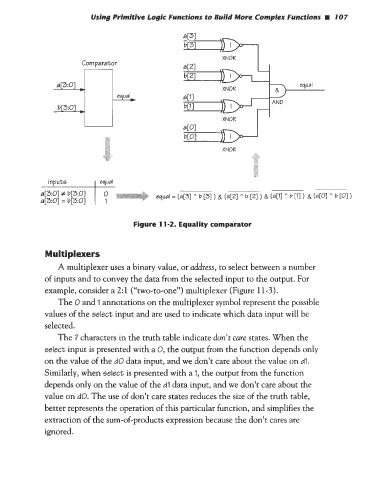
                                     Figure 11-2. Equality comparator


             Mu It i plexe rs

                 A multiplexer uses a binary value, or address, to select between a number
             of inputs and to convey the data from the selected input to the output. For
             example, consider a 2:l ("two-to-one") multiplexer (Figure 11-3).
                 The O and I  annotations on the multiplexer symbol represent the possible
             values of the select input and are used to indicate which data input will be
             selected.
                 The ? characters in the truth table indicate don't care states. When the
             select input is presented with a 0, the output from the function depends only
             on the value of the dO data input, and we don't care about the value on dl.
             Similarly, when select is presented with a I, the output from the function
             depends only on the value of the dl data input, and we don't care about the
             value on do. The use of don't care states reduces the size of the truth table,
             better represents the operation of this particular function, and simplifies the
             extraction of the sum-of-products expression because the don't cares are
             ignored.

