


Page 128 - Bebop to The Boolean Boogie An Unconventional Guide to Electronics Fundamentals, Components, and Processes
P. 128
Using Primitive Logic Functions to Build More Complex Functions  w  109

                  Larger multiplexers are also common in designs: for example, 4: 1 multi-
              plexers with four data inputs feeding one output and 8: 1 multiplexers with
              eight data inputs feeding one output. In the case of a 4:l  multiplexer, we will
              require two select inputs to choose between the four data inputs (using binary
              patterns of 00, 01, 10, and 11). Similarly, in the case of an 8:l multiplexer, we
              will require three select inputs to choose between the eight data inputs (using
              binary patterns of OOO,OOI,OIO,  011,100, 101,110, and 111).


              Decoders
                 A decoder uses a binary value, or address, to select between a number
              of outputs and to assert the selected output by placing it in its active state.
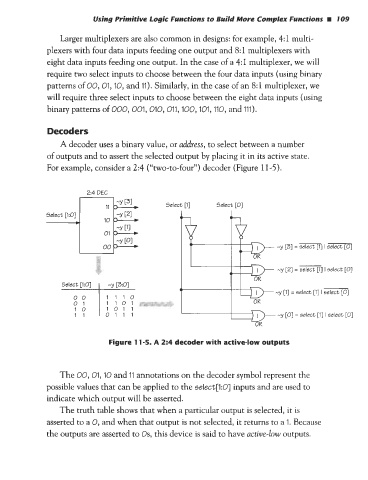
              For example, consider a 2:4  (“two-to-four”) decoder (Figure 11-5).


                         2:4 DEC


                                                                                   --
                                                                                   --
                                                                             -y
                                                                             -y  [3] = select [l]  I select [0]
                                                                                   select
                                                                                  =
                                                                               [3]
                                                                                        [l]
                                                                                               [0]
                                                                                          I
                                                                                           select
                                                                                               [0]
                                                                               [2]
                                                                                  =
                                                                                        [I]
                                                                             -y  [2] = select [I]  I select [0]
                                                                                          I
                                                                                   select
                                                                             -y
                                                                                           select
                                                                            -y  [I]  = select [I ]  I select [0]
                                                                             -y  [0] = select [I]  I select [0]
                                                                       OK
                               Figure 11-5. A 2:4  decoder with active-low outputs
                 The 00,01,10 and 11 annotations on the decoder symbol represent the
              possible values that can be applied to the seIect[I:0] inputs and are used to
              indicate which output will be asserted.
                 The truth table shows that when a particular output is selected, it is
              asserted to a 0, and when that output is not selected, it returns to a 1.  Because
              the outputs are asserted to Os, this device is said to have active-low outputs.

