


Page 122 - Bebop to The Boolean Boogie An Unconventional Guide to Electronics Fundamentals, Components, and Processes
P. 122
Karnaugh Maps      103


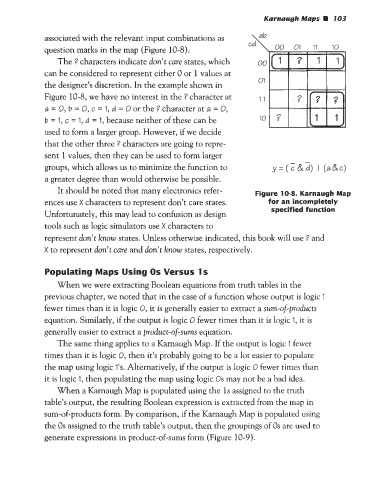
             associated with the relevant input combinations as
             question marks in the map (Figure 10-8).                C   K  00   01    11   10
                The ? characters indicate don’t cure states, which
             can be considered to represent either 0 or 1 values at     011  I  I  I  I
             the designer’s discretion. In the example shown in
             Figure 10-8, we have no interest in the ? character at     11
             a = 0, b = 0, = 1,  d = 0 or the ? character at a = 0,
                          c
             b = 1,  c = 1,  d  = 1,  because neither of these can be   10
             used to form a larger group. However, if we decide
             that the other three ? characters are going to repre-
             sent 1 values, then they can be used to form larger
             groups, which allows us to minimize the function to
             a greater degree than would otherwise be possible.
                 It should be noted that many electronics refer-       Figure 10-8. Karnaugh Map
             ences use X characters to represent don’t care states.       for an incompletely
                                                                           specified function
             Unfortunately, this may lead to confusion as design
             tools such as logic simulators use X characters to
             represent don’t know states. Unless otherwise indicated, this book will use ? and
             X to represent don’t cure and don’t know states, respectively.


             Populating Maps Using Os Versus 1s
                When we were extracting Boolean equations from truth tables in the
             previous chapter, we noted that in the case of a function whose output is logic I
             fewer times than it is logic 0, is generally easier to extract a sum-of-products
                                          it
             equation. Similarly, if the output is logic 0 fewer times than it is logic I, it is
             generally easier to extract a product-of-sums equation.
                The same thing applies to a Karnaugh Map. If the output is logic 1 fewer
             times than it is logic 0, then it’s probably going to be a lot easier to populate
             the map using logic 1‘s. Alternatively, if the output is logic 0 fewer times than
             it is logic I, then populating the map using logic Os may not be a bad idea.
                When a Karnaugh Map is populated using the 1s assigned to the truth
             table’s output, the resulting Boolean expression is extracted from the map in
             sum-of-products form. By comparison, if the Karnaugh Map is populated using
             the Os  assigned to the truth table’s output, then the groupings of Os  are used to
             generate expressions in product-of-sums form (Figure 10-9).

