


Page 118 - Bebop to The Boolean Boogie An Unconventional Guide to Electronics Fundamentals, Components, and Processes
P. 118
Karnaugh Maps     99


                                                        y=(Z&6&c) I(E&b&c)  I (a&E&Z) I  (a&6&c)
                                                                   Sum-of-Products Expression


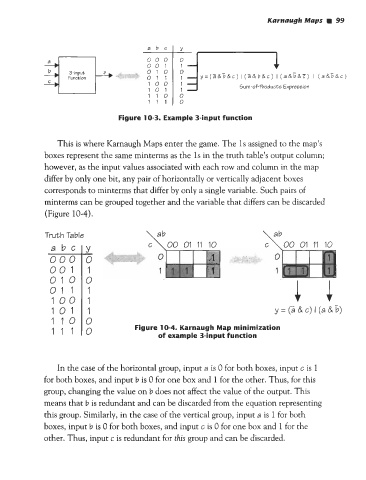
                                  Figure 10-3. Example 3-input function


                 This is where Karnaugh Maps enter the game. The 1s assigned to the map’s
             boxes represent the same minterms as the 1s in the truth table’s output column;
             however, as the input values associated with each row and column in the map
             differ by only one bit, any pair of horizontally or vertically adjacent boxes
             corresponds to minterms that differ by only a single variable. Such pairs of
             minterms can be grouped together and the variable that differs can be discarded
             (Figure 10-4).


             Truth Table
                                         Yo0 01  11  10                  Yo0 01  11  10


                                                                                  11


                                      Figure 10-4. Karnaugh Map minimization
                                             of example 3-input function


                 In the case of the horizontal group, input a is 0 for both boxes, input c is 1
             for both boxes, and input b is 0 for one box and 1 for the other. Thus, for this
             group, changing the value on b does not affect the value of the output. This
             means that b is redundant and can be discarded from the equation representing
             this group. Similarly, in the case of the vertical group, input a is 1 for both
             boxes, input b is 0 for both boxes, and input c is 0 for one box and 1 for the
             other. Thus, input c is redundant for this group and can be discarded.

