


Page 119 - Bebop to The Boolean Boogie An Unconventional Guide to Electronics Fundamentals, Components, and Processes
P. 119
100 rn  Chapter Ten

                Grouping Minterms
                   In the case of a 3-input Karnaugh Map, any two horizontally or vertically
                adjacent minterms, each composed of three variables, can be combined to form
                a new product term composed of only two variables. Similarly, in the case of a
                4-input map, any two adjacent minterms, each composed of four variables, can
                be combined to form a new product term composed of only three variables.
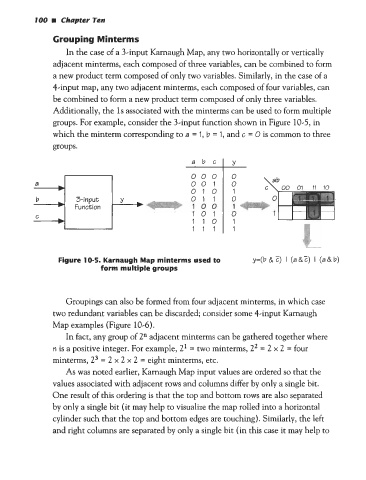
                Additionally, the 1s associated with the minterms can be used to form multiple
                groups. For example, consider the 3-input function shown in Figure 10-5, in
                which the minterm corresponding to a = 1,  b = 1,  and c = 0 is common to three
                groups.

                                                      abc        Y

                                                      000
                                                      00 1
                                                      0  1  0
                      3-input     Y                   0  1  1
                      Function                        100
                                                      1 0 1
                                                      1 1 0
                                                      1 1 1      1


                 Figure 10-5. Karnaugh Map minterms used to            y=(b  & Z)  I  (a&;)   I  (a& b)
                             form multiple groups


                   Groupings can also be formed from four adjacent minterms, in which case
                two redundant variables can be discarded; consider some 4-input Karnaugh
                Map examples (Figure 10-6).
                   In fact, any group of 2"  adjacent minterms can be gathered together where
                n is a positive integer. For example, 2l = two minterms, 22 = 2 x 2 = four
                minterms, Z3  = 2 x 2 x 2 = eight minterms, etc.
                   As was noted earlier, Karnaugh Map input values are ordered so that the
                values associated with adjacent rows and columns differ by only a single bit.
                One result of this ordering is that the top and bottom rows are also separated
                by only a single bit (it may help to visualize the map rolled into a horizontal
                cylinder such that the top and bottom edges are touching). Similarly, the left
                and right columns are separated by only a single bit (in this case it may help to

