


Page 157 - Bebop to The Boolean Boogie An Unconventional Guide to Electronics Fundamentals, Components, and Processes
P. 157
138    Chapter Twelve

              program can be used to obtain the same results in less time with far fewer
              opportunities for error.6 Whichever technique is employed, the state
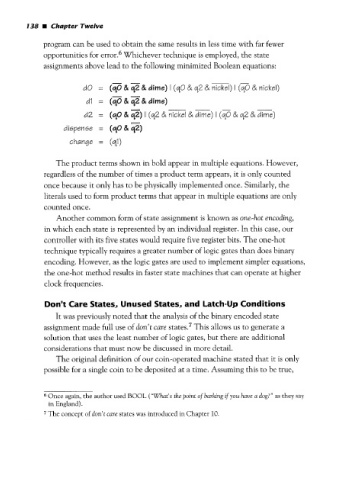
              assignments above lead to the following minimized Boolean equations:


                          dO  =  (T & $&  dime) I  (40 & 42 & nickel) I  (010 & nickel)
                                  -_.
                          dl  =  (qO&q2&dime)
                                            I
                                                                      &
                          d2  =  (q0 & F) (42 & niGkel& dime) I  (q 42 & dime)
                    dispense  =  (qO&q)
                      change  =  (ql)


                  The product terms shown in bold appear in multiple equations. However,
              regardless of the number of times a product term appears, it is only counted
              once because it only has to be physically implemented once. Similarly, the
              literals used to form product terms that appear in multiple equations are only
              counted once.
                  Another common form of state assignment is known as one-hot encoding,
              in which each state is represented by an individual register. In this case, our
              controller with its five states would require five register bits. The one-hot

              technique typically requires a greater number of  logic gates than does binary
              encoding. However, as the logic gates are used to implement simpler equations,
              the one-hot method results in faster state machines that can operate at higher

              clock frequencies,

              Don’t Care States, Unused States, and Latch-Up Conditions

                  It was previously noted that the analysis of the binary encoded state
              assignment made full use of don’t cure  state^.^ This allows us to generate a
              solution that uses the least number of logic gates, but there are additional
              considerations that must now be discussed in more detail.
                  The original definition of our coin-operated machine stated that it is only
              possible for a single coin to be deposited at a time. Assuming this to be true,


              6 Once again, the author used BOOL (“What’s the point of  barking if  you have a dog?” as they say
                in England).
              7 The concept of don’t care states was introduced in Chapter 10.

