


Page 153 - Bebop to The Boolean Boogie An Unconventional Guide to Electronics Fundamentals, Components, and Processes
P. 153
134    Chapter Twelve
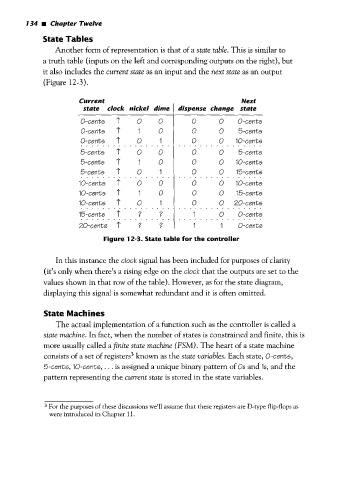
              State Tables
                 Another form of representation is that of a state table. This is similar to
              a truth table (inputs on the left and corresponding outputs on the right), but
              it also includes the current state as an input and the next state as an output
              (Figure 12-3).


                         Current                                         Next
                          state  clock  nickel  dime I  dispense  change  state
                         0-cents    'T    o     o         0       0     0-cents
                         0-cents    1'    I     0         0       0     5-cents
                         5-cents  +       o     o         0       0    10-cents
                                    1'
                                                 1
                         0-cents
                         ................  ................
                                          o
                                                                  0
                                                          0
                                                                        5-cents
                         5-cents  1'      1     0         0       0    10-cents
                         5-cents  1'      o      1        0       0    15-cents
                         ................  ................
                         ~o-cents  1;     o     o         0       0    10-cents
                         10-cents  1'     I     0         0       0    15-cents
                         10-cents  1'     o      1        0       0    20-cents
                         15-cents  r      ?      ?         1      0     0-cents
                         ................  ................
                         ................  ................
                         20-cents  f      ?      ?         1       1    0-cents
                                Figure 12-3. State table for the controller


                  In this instance the clock signal has been included for purposes of clarity
              (it's only when there's a rising edge on the clock that the outputs are set to the
              values shown in that row of the table). However, as for the state diagram,
              displaying this signal is somewhat redundant and it is often omitted.

              State Machines
                  The actual implementation of a function such as the controller is called a
              state machine. In fact, when the number of states is constrained and finite, this is
              more usually called a finite state machine (FSM) . The heart of a state machine
              consists of  a set of registers3 known as the state variables. Each state, 0-cents,
              5-cent5, IO-cents, ... is assigned a unique binary pattern of Os and Is, and the
              pattern represenring the current state is stored in the state variables.


              3 For the purposes of these discussions we'll assume that these registers are D-type flip-flops as
                were introduced in Chapter 1 1.

