


Page 150 - Bebop to The Boolean Boogie An Unconventional Guide to Electronics Fundamentals, Components, and Processes
P. 150
State Diagrams, State


                  Tables, and State Machines


                  Consider a coin-operated machine that accepts nickels and dimes’ and,
              for the princely sum of fifteen cents, dispenses some useful article called a
              “gizmo” that the well-dressed man-about-town could not possibly be without.
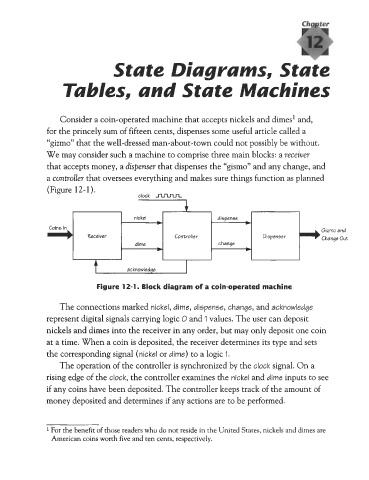
              We may consider such a machine to comprise three main blocks: a receiver
              that accepts money, a dispenser that dispenses the “gismo” and any change, and
              a controller that oversees everything and makes sure things function as planned
              (Figure 12-1).


                                      nickel                 dispense
                                            b                       b
               Colne In
                                                                                         Gizmo and
                         Receiver                Controller              Dispenser       Change Out
                                      dime                   change
                                            b                       b


                            Figure 12-1. Block diagram of a coin-operated machine


                 The connections marked nickel, dime, dispense, change, and acknowledge
              represent digital signals carrying logic 0 and 1 values. The user can deposit
              nickels and dimes into the receiver in any order, but may only deposit one coin
              at a time. When a coin is deposited, the receiver determines its type and sets
              the corresponding signal (nickel or dime) to a logic 1.
                 The operation of the controller is synchronized by the clock signal. On a
              rising edge of the clock,  the controller examines the nickel and dime inputs to see
              if any coins have been deposited. The controller keeps track of the amount of
              money deposited and determines if any actions are to be performed.


              1 For the benefit of those readers who do not reside in the United States, nickels and dimes are
               American coins worth five and ten cents, respectively.

