


Page 147 - Bebop to The Boolean Boogie An Unconventional Guide to Electronics Fundamentals, Components, and Processes
P. 147
128 w  Chapter Eleven

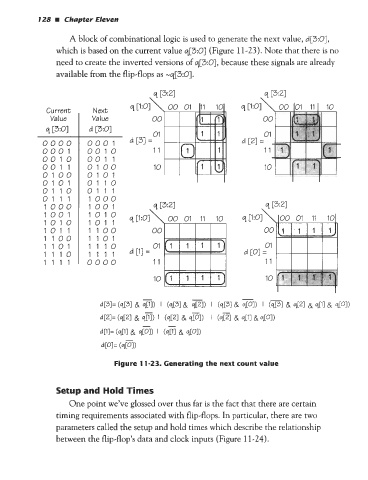
                    A block of combinational logic is used to generate the next value, d[3:0],
                which is based on the current value q[3:O] (Figure 11-23). Note that there is no
                need to create the inverted versions of q[3:O], because these signals are already
                available from the flip-flops as -q[3:0].


              Current      Next
               Value      Value
              q [3:01    d [3:0]
             0000        000  1
             000  1      0010
             0010        001 1
             001 1       0100
             0100        0101
             0101        01 10
             01 10       01 11
             01 11       1000
             1000        1001
             1001        I010       q[I:Olh 00, 01 ,  11 ,  IO,
             I010        101 1
             101 1       1100
             1100        1101
             1101        11 10             01
             11 10       1111       d [I]  =
             1111        0000              111  I  I  I        I

                                           10  1


                                Figure 1 1-23. Generating the next count value


                Setup and Hold Times
                    One point we’ve glossed over thus far is the fact that there are certain
                timing requirements associated with flip-flops. In particular, there are two
                parameters called the setup and hold times which describe the relationship
                between the flip-flop’s data and clock inputs (Figure 11-24).

