


Page 143 - Bebop to The Boolean Boogie An Unconventional Guide to Electronics Fundamentals, Components, and Processes
P. 143
124  H Chapter Eleven


                         j                   s.                              01

                                   >
                         clock
                                                          clock     >       3-q
                         k                  3-q
                                   i   I                                I


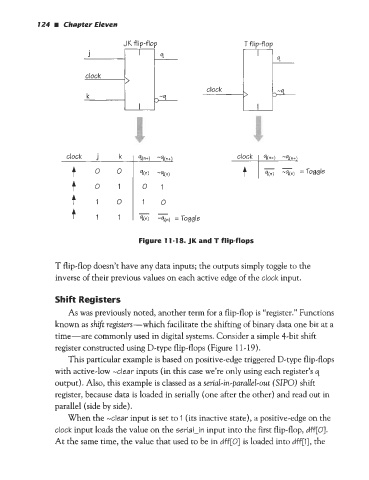
                                       Figure 11-18, JK and T flip-flops


                T flip-flop doesn’t have any data inputs; the outputs simply toggle to the
                inverse of their previous values on each active edge of the clock input.

                Shift Registers

                    As was previously noted, another term for a flip-flop is “register.” Functions
                known as shift registers-which   facilitate the shifting of binary data one bit at a
                time-are   commonly used in digital systems. Consider a simple 4-bit shift
                register constructed using D-type flip-flops (Figure 1 1 - 19).
                    This particular example is based on positive-edge triggered D-type flip-flops
                with active-low -clear  inputs (in this case we’re only using each register’s q
                output). Also, this example is classed as a serial-in-parallel-out (SIPO) shift
                register, because data is loaded in serially (one after the other) and read out in
                parallel (side by side).
                    When the -clear  input is set to I  (its inactive state), a positive-edge on the
                clock input loads the value on the serial-in  input into the first flip-flop, dff[O].
                At the same time, the value that used to be in dff[O]  is loaded into dff[I],  the

