


Page 141 - Bebop to The Boolean Boogie An Unconventional Guide to Electronics Fundamentals, Components, and Processes
P. 141
122  rn  Chapter €le ven


                1   _-_-__      I
                                I
          data                  I  I                I  I
                                I
                0-              1                   I  I
                1   ------------
          clock
                0-

                1
             01    xxxxxx
                0

                1
             -4,   xxxxxxl
                0

                                                                                         Time

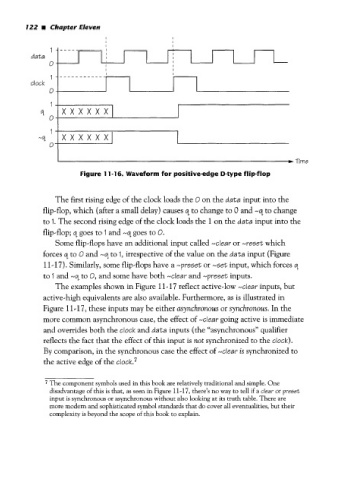
                         Figure 1 1-1 6. Waveform for positive-edge D-type flip-flop


                 The first rising edge of the clock loads the 0 on the data input into the
              flip-flop, which (after a small delay) causes 9 to change to 0 and -9 to change
              to 1.  The second rising edge of the clock loads the 1 on the data input into the
              flip-flop; q goes to I  and -9 goes to 0.
                  Some flip-flops have an additional input called -clear  or -reset which
              forces 9 to 0 and -4 to 1,  irrespective of the value on the data input (Figure
              11-17). Similarly, some flip-flops have a -preset  or -set  input, which forces q
              to I  and -01  to 0, and some have both -clear  and -preset  inputs.
                  The examples shown in Figure 11-17 reflect active-low -clear  inputs, but
              active-high equivalents are also available. Furthermore, as is illustrated in
              Figure 11-17, these inputs may be either asynchronous or synchronous. In the
              more common asynchronous case, the effect of -clear  going active is immediate
              and overrides both the clock and data inputs (the ((asynchronous” qualifier
              reflects the fact that the effect of this input is not synchronized to the clock).
              By comparison, in the synchronous case the effect of -clear  is synchronized to
              the active edge of the clock.7


              7 The component symbols used in this book are relatively traditional and simple. One
                disadvantage of this is that, as seen in Figure 11-17, there’s no way to tell if a clear or preset
                input is synchronous or asynchronous without also looking at its truth table. There are
                more modem and sophisticated symbol standards that do cover all eventualities, but their
                complexity is beyond the scope of this book to explain.

