


Page 142 - Bebop to The Boolean Boogie An Unconventional Guide to Electronics Fundamentals, Components, and Processes
P. 142
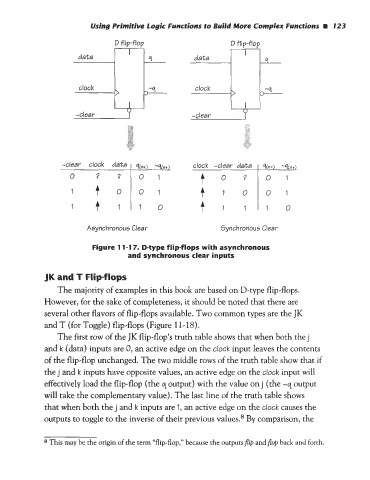
Using Primitive Logic Functions to Build More Complex Functions  W  123


                                     I                              I
                       data               4            data               4


                       clock     >        -4           clock     >        -4

                                     I                              I


                                             0                                  0

                         Asynchronous Clear                   5ynchronous Clear


                           Figure 1 1-1 7.  D-type flip-flops with asynchronous
                                    and synchronous clear inputs


             JK and T Flip-flops
                 The majority of examples in this book are based on D-type flip-flops.
             However, for the sake of completeness, it should be noted that there are
             several other flavors of flip-flops available. Two common types are the JK
             and T (for Toggle) flip-flops (Figure 1 1 - 18).
                 The first row of the JK flip-flop’s truth table shows that when both the j
             and k (data) inputs are 0, an active edge on the clock input leaves the contents
             of the flip-flop unchanged. The two middle rows of  the truth table show that if
             the j and k inputs have opposite values, an active edge on the clock input will
             effectively load the flip-flop (the q output) with the value on j (the -q output
             will take the complementary value). The last line of the truth table shows
             that when both the j and k inputs are 1,  an active edge on the clock causes the
             outputs to toggle to the inverse of their previous values.8 By comparison, the


               This may be the origin of the term “flip-flop,” because the outputs flip and flop back and forth.

