


Page 151 - Bebop to The Boolean Boogie An Unconventional Guide to Electronics Fundamentals, Components, and Processes
P. 151
732 rn  Chapter Twelve

                   Every time the controller inspects the nickel and dime signals, it sends an
               acknowledge signal back to the receiver. The acknowledge signal informs the
               receiver that the coin has been accounted for, and the receiver responds by
               resetting the nickel and dime signals to 0 and awaiting the next coin. The
               acknowledge signal can be generated in a variety of ways which are not
               particularly relevant here.
                   When the controller decides that sufficient funds have been deposited,
               it instructs the dispenser to dispense a “gizmo” and any change (if necessary)
               by setting the dispense and change signals to 1,  respectively.


               State Diagrams

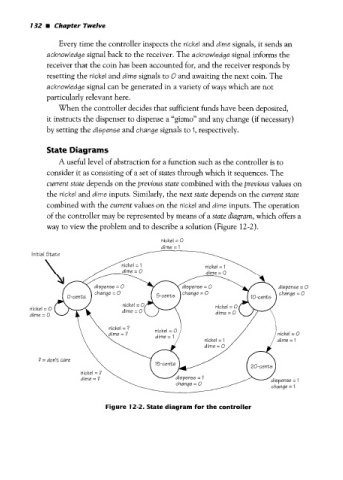
                   A useful level of abstraction for a function such as the controller is to
               consider it as consisting of a set of states through which it sequences. The
               current state depends on the previous stute combined with the previous values on

               the nickel and dime inputs. Similarly, the next state depends on the current state
               combined with the current values on the nickel and dime inputs. The operation
               of the controller may be represented by means of a state diagram, which offers a
               way to view the problem and to describe a solution (Figure 12-2).


                                 Figure 12-2. State diagram for the controller

