


Page 159 - Bebop to The Boolean Boogie An Unconventional Guide to Electronics Fundamentals, Components, and Processes
P. 159
Analog-to-Digital and

                                                Digital-to-A nalog


                     As we began our discussions in Chapter 1 by separating the analog and

                  digital views of the world, it seems appropriate to close this section of  the book
                  by reuniting them. While some systems operate solely on digital data, others
                  have to interact with the analog world. It may be necessary to convert an
                  analog input into a form that can be manipulated by the digital system, or to
                  transform an output from a digital system into the analog realm. These tasks are
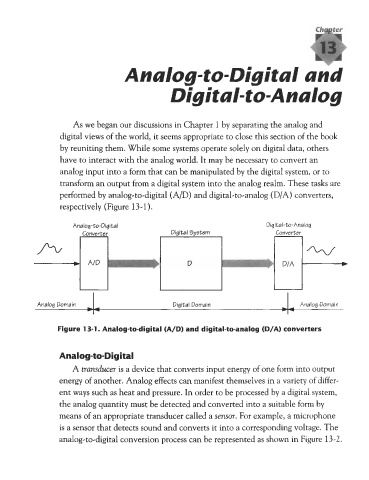
                 performed by analog-to-digital (A/D) and digital-to-analog (D/A) converters,
                  respectively (Figure 13 - 1 ) .
                                                                            Fpb

                     Analog-to-Digital                                    Digital-to-Analog
                        Converter               Digital System               Converter


           Analog Domain                         Digital Domain                    Analog Domain


                 Figure 1 3-1. Analog-to-digital (A/D)  and digital-to-analog (D/A)  converters


                 Analog-to-Dig ita1
                     A transducer is a device that converts input energy of one form into output
                 energy of another. Analog effects can manifest themselves in a variety of differ-
                 ent ways such as heat and pressure. In order to be processed by a digital system,
                 the analog quantity must be detected and converted into a suitable form by
                 means of an appropriate transducer called a sensor. For example, a microphone
                 is a sensor that detects sound and converts it into a corresponding voltage. The
                 analog-to-digital conversion process can be represented as shown in Figure 13-2.

