


Page 164 - Bebop to The Boolean Boogie An Unconventional Guide to Electronics Fundamentals, Components, and Processes
P. 164
Integrated Circuits (ICs)   145


            single integrated circuit, which is typically in the region of  lmm x lmm to
             lOmm x lOmm, but may be even larger. After the area corresponding to one
             integrated circuit has been exposed, the wafer is moved and the process is
            repeated until the pattern has been replicated across the whole of the wafer’s
             surface. This technique for duplicating the pattern is called a step-and-repeat
            process.
                As we shall see, multiple layers are required to construct the transistors
             (and other components), where each layer requires its own unique mask. Once
             all of the transistors have been created, similar techniques are used to lay down
             the tracking (wiring) layers that connect the transistors together.

             A More Detailed Look at the Fabrication Process

                To illustrate the manufacturing process in more detail, we will consider the
             construction of a single NMOS transistor occupying an area far smaller than a
             speck of dust. For reasons of electronic stability, the majority of processes begin
             by lightly doping the entire wafer to form either N-type or, more commonly,
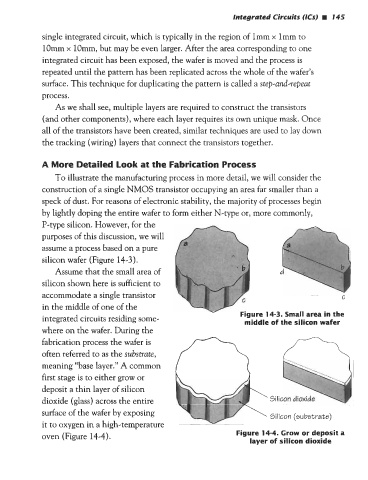
             P-type silicon. However, for the
             purposes of this discussion, we will
             assume a process based on a pure
             silicon wafer (Figure 14-3).

                Assume that the small area of
             silicon shown here is sufficient to
             accommodate a single transistor
             in the middle of one of the
             integrated circuits residing some-                     middle of the silicon wafer
             where on the wafer. During the
             fabrication process the wafer is
             often referred to as the substrate,
             meaning “base layer.” A common
             first stage is to either grow or
             deposit a thin layer of silicon
             dioxide (glass) across the entire
             surface of the wafer by exposing
             it to oxygen in a high-temperature
             oven (Figure 14-4).                                  Figure 14-4. Grow or deposit a
                                                                      layer of silicon dioxide

