


Page 168 - Bebop to The Boolean Boogie An Unconventional Guide to Electronics Fundamentals, Components, and Processes
P. 168
Integrated Circuits (ICs)   149

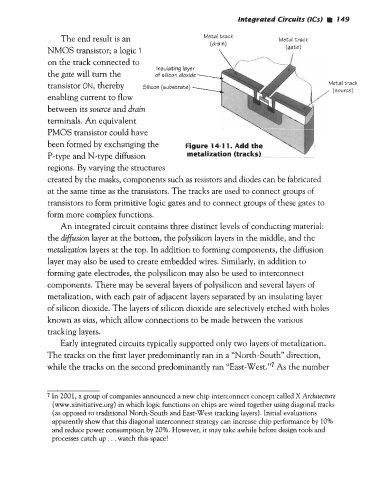
                  The end result is an                   Metal track         Metal track
              NMOS transistor; a logic 1
              on the track connected to
              the gate will turn the        of silicon dioxide
              transistor ON, thereby    ~i~icon (substrate)                                Metal track
              enabling current to flow                                                 / (source)
              between its source and drain                                            I
              terminals. An equivalent                                                /
              PMOS transistor could have
              been formed by exchanging the         Figure 14-1 1 I
              P-type and N-type diffusion           metalization (tracks)
              regions. By varying the structures
              created by the masks, components such as resistors and diodes can be fabricated
              at the same time as the transistors. The tracks are used to connect groups of
              transistors to form primitive logic gates and to connect groups of these gates to
              form more complex functions.
                  An integrated circuit contains three distinct levels of conducting material:
              the diffusion layer at the bottom, the polysilicon layers in the middle, and the
              metalimion layers at the top. In addition to forming components, the diffusion
              layer may also be used to create embedded wires. Similarly, in addition to
              forming gate electrodes, the polysilicon may also be used to interconnect
              components. There may be several layers of polysilicon and several layers of
              metalization, with each pair of adjacent layers separated by an insulating layer
              of silicon dioxide. The layers of silicon dioxide are selectively etched with holes
              known as vias, which allow connections to be made between the various
              tracking layers.
                  Early integrated circuits typically supported only two layers of metalization.
              The tracks on the first layer predominantly ran in a “North-South” direction,
                                                                             As
              while the tracks on the second predominantly ran “Ea~t-West.”~ the number


              7 In 2001, a group of  companies announced a new chip interconnect concept called X Architecture
               (www.xinitiative.org) in which logic functions on chips are wired together using diagonal tracks
                (as opposed to traditional North-South and East-West tracking layers). Initial evaluations
               apparently show that this diagonal interconnect strategy can increase chip performance by 10%
               and reduce power consumption by 20%. However, it may take awhile before design tools and
               processes catch up. . . watch this space!

