


Page 166 - Bebop to The Boolean Boogie An Unconventional Guide to Electronics Fundamentals, Components, and Processes
P. 166
Integrated Circuits (ICs)  H  I4 7


              pattern on the mask has
              been transferred to a series
              of corresponding patterns in
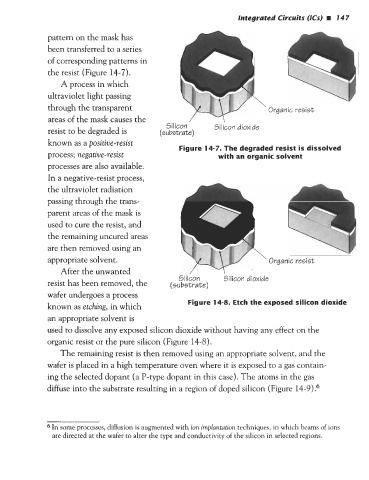
              the resist (Figure 14-7).

                  A process in which
              ultraviolet light passing
              through the transparent                                      Organic resist
              areas of the mask causes the
                                               Silicon
              resist to be degraded is       (su bstxate)   Silicon dioxide
              known as a positive-resist          Figure 14-7. The degraded resist is dissolved
              process; negative-resist                       with an organic solvent
              processes are also available.
              In a negative-resist process,
              the ultraviolet radiation
              passing through the trans-
              parent areas of the mask is
              used to cure the resist, and
              the remaining uncured areas
              are then removed using an
              appropriate solvent.                                         Organic resist
                  After the unwanted
                                                  Silicon      5ilicon dioxide
              resist has been removed, the      (su bstrate)
              wafer undergoes a process
                                                     Figure 14-8. Etch the exposed silicon dioxide
              known as etching, in which
              an appropriate solvent is
              used to dissolve any exposed silicon dioxide without having any effect on the
              organic resist or the pure silicon (Figure 14-8).
                  The remaining resist is then removed using an appropriate solvent, and the
              wafer is placed in a high temperature oven where it is exposed to a gas contain-
              ing the selected dopant (a P-type dopant in this case). The atoms in the gas
              diffuse into the substrate resulting in a region of doped silicon (Figure 14-9).6


              6 In some processes, diffusion is augmented with ion implantation techniques, in which beams of  ions
               are directed at the wafer to alter the type and conductivity of the silicon in selected regions.

