


Page 161 - Bebop to The Boolean Boogie An Unconventional Guide to Electronics Fundamentals, Components, and Processes
P. 161
142  H  Chapter Thirfeen

                     The sampling usually occurs at regular time intervals and is triggered by the
                 digital part of the system. The complete range of values that the analog signal
                 can assume is divided into a set of discrete bands or quanta. At each sample
                  time, the A/D converter determines which band the analog signal falls into
                  (this is the “quantization” part of the process) and outputs the equivalent
                 binary code for that band.
                     The main factor governing the accuracy of the conversion is the number
                 of bands used. For example, a 3-bit code can represent only eight bands, each
                 encompassing 12.5% of the analog signal’s range, while a 12-bit code can
                 represent 4,096 bands, each encompassing  0.025% of the signal’s range.


                  Dig ital-to-Analog
                     A D/A converter accepts a digital code and transforms it into a correspond-
                  ing analog current or voltage suitable for use by means of an appropriate trans-
                 ducer called an actuator. For example, a loudspeaker is an actuator that converts
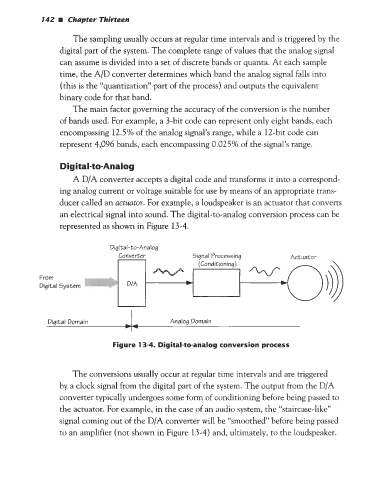
                 an electrical signal into sound. The digital-to-analog conversion process can be
                 represented as shown in Figure 13-4.


                               Digital-to- Analog
                                 n                    Signal Processing   -      Actuator
                                                       (Conditioning)


              Digital Domain                    Analog Domain
                                   b4

                                Figure 1 3-4. Digital-to-analog conversion process


                     The conversions usually occur at regular time intervals and are triggered
                 by a clock signal from the digital part of the system. The output from the D/A
                 converter typically undergoes some form of conditioning before being passed to
                 the actuator. For example, in the case of an audio system, the “staircase-like”
                 signal coming out of the D/A converter will be “smoothed” before being passed
                 to an amplifier (not shown in Figure 13-4) and, ultimately, to the loudspeaker.

