


Page 329 - Biodegradable Polyesters
P. 329
12.4  Biodegradable Stents  307

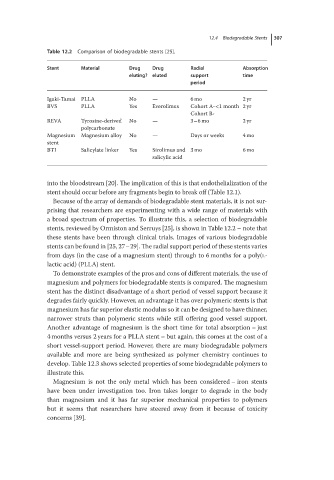
               Table 12.2 Comparison of biodegradable stents [25].

               Stent    Material      Drug   Drug       Radial         Absorption
                                      eluting? eluted   support        time
                                                        period

               Igaki-Tamai  PLLA      No     —          6 mo           2 yr
               BVS      PLLA          Yes    Everolimus  Cohort A-<1month 2 yr
                                                        Cohort B-
               REVA     Tyrosine-derived  No  —         3–6 mo         2 yr
                        polycarbonate
               Magnesium  Magnesium alloy  No  —        Days or weeks  4 mo
               stent
               BTI      Salicylate linker  Yes  Sirolimus and 3mo      6 mo
                                             salicylic acid


               into the bloodstream [20]. The implication of this is that endothelialization of the
               stent should occur before any fragments begin to break off (Table 12.1).
                Because of the array of demands of biodegradable stent materials, it is not sur-
               prising that researchers are experimenting with a wide range of materials with
               a broad spectrum of properties. To illustrate this, a selection of biodegradable
               stents, reviewed by Ormiston and Serruys [25], is shown in Table 12.2 – note that
               these stents have been through clinical trials. Images of various biodegradable
               stents can be found in [25, 27–29]. The radial support period of these stents varies
               from days (in the case of a magnesium stent) through to 6 months for a poly(L-
               lactic acid) (PLLA) stent.
                To demonstrate examples of the pros and cons of different materials, the use of
               magnesium and polymers for biodegradable stents is compared. The magnesium
               stenthas thedistinctdisadvantageofashort period of vessel support becauseit
               degrades fairly quickly. However, an advantage it has over polymeric stents is that
               magnesium has far superior elastic modulus so it can be designed to have thinner,
               narrower struts than polymeric stents while still offering good vessel support.
               Another advantage of magnesium is the short time for total absorption – just
               4 months versus 2 years for a PLLA stent – but again, this comes at the cost of a
               short vessel-support period. However, there are many biodegradable polymers
               available and more are being synthesized as polymer chemistry continues to
               develop. Table 12.3 shows selected properties of some biodegradable polymers to
               illustrate this.
                Magnesium is not the only metal which has been considered – iron stents
               have been under investigation too. Iron takes longer to degrade in the body
               than magnesium and it has far superior mechanical properties to polymers
               but it seems that researchers have steered away from it because of toxicity
               concerns [39].

