


Page 432 - Biofuels for a More Sustainable Future
P. 432
384 Biofuels for a More Sustainable Future
in each dimension, a focus group meeting in which two professors whose
research focused on sustainability engineering and renewable energy, two
senior chemical engineers, two environmentalists, two senior managers
from renewable energy companies, and two residents who live near the
plants for bioenergy production were invited to participate in was held in
Chongqing, China on 7th August 2017. The participants discussed for estab-
lishing the comparison matrices for determining the weights of three pillars
of sustainability and the local weights of the criteria in each pillar. Taking the
weights of the three pillars as an example:
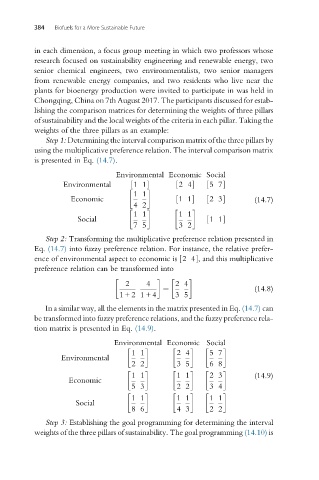
Step 1: Determining the interval comparison matrix of the three pillars by
using the multiplicative preference relation. The interval comparison matrix
is presented in Eq. (14.7).
Environmental Economic Social
Environmental ½ 1 1 ½ 24 ½ 57
1 1
Economic ½ 11 ½ 23 (14.7)
4 2
1 1 1 1
Social ½ 11
7 5 3 2
Step 2: Transforming the multiplicative preference relation presented in
Eq. (14.7) into fuzzy preference relation. For instance, the relative prefer-
ence of environmental aspect to economic is 2 4, and this multiplicative
½
preference relation can be transformed into
2 4 2 4
¼ (14.8)
1+2 1+4 3 5
In a similar way, all the elements in the matrix presented in Eq. (14.7) can
be transformed into fuzzy preference relations, and the fuzzy preference rela-
tion matrix is presented in Eq. (14.9).
Environmental Economic Social
1 1 2 4 5 7
Environmental
2 2 3 5 6 8
1 1 1 1 2 3 (14.9)
Economic
5 3 2 2 3 4
1 1 1 1 1 1
Social
8 6 4 3 2 2
Step 3: Establishing the goal programming for determining the interval
weights of the three pillars of sustainability. The goal programming (14.10) is

