


Page 436 - Biofuels for a More Sustainable Future
P. 436
388   Biofuels for a More Sustainable Future


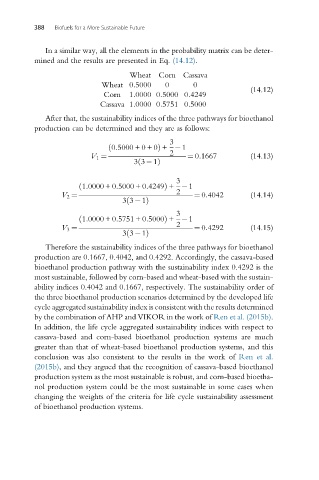
             In a similar way, all the elements in the probability matrix can be deter-
          mined and the results are presented in Eq. (14.12).
                                    Wheat Corn Cassava
                            Wheat 0:5000      0      0
                                                                     (14.12)
                             Corn   1:0000 0:5000 0:4249
                            Cassava 1:0000 0:5751 0:5000

             After that, the sustainability indices of the three pathways for bioethanol
          production can be determined and they are as follows:
                                               3
                              ð 0:5000 + 0 + 0Þ +  1
                                               2
                         V 1 ¼                      ¼ 0:1667         (14.13)
                                      ð
                                     33 1Þ
                                                 3
                      ð 1:0000 + 0:5000 + 0:4249Þ +  1
                                                 2
                  V 2 ¼                              ¼ 0:4042        (14.14)
                                  33 1Þ
                                   ð
                                                 3
                      ð 1:0000 + 0:5751 + 0:5000Þ +  1
                                                 2
                  V 3 ¼                              ¼ 0:4292        (14.15)
                                   ð
                                  33 1Þ
             Therefore the sustainability indices of the three pathways for bioethanol
          production are 0.1667, 0.4042, and 0.4292. Accordingly, the cassava-based
          bioethanol production pathway with the sustainability index 0.4292 is the
          most sustainable, followed by corn-based and wheat-based with the sustain-
          ability indices 0.4042 and 0.1667, respectively. The sustainability order of
          the three bioethanol production scenarios determined by the developed life
          cycle aggregated sustainability index is consistent with the results determined
          by the combination of AHP and VIKOR in the work of Ren et al. (2015b).
          In addition, the life cycle aggregated sustainability indices with respect to
          cassava-based and corn-based bioethanol production systems are much
          greater than that of wheat-based bioethanol production systems, and this
          conclusion was also consistent to the results in the work of Ren et al.
          (2015b), and they argued that the recognition of cassava-based bioethanol
          production system as the most sustainable is robust, and corn-based bioetha-
          nol production system could be the most sustainable in some cases when
          changing the weights of the criteria for life cycle sustainability assessment
          of bioethanol production systems.

