


Page 127 - Biorefinery 2030 Future Prospects for the Bioeconomy (2015)
P. 127
5  Maintaining or Renewing the Virtues of the Cooperative Model  95


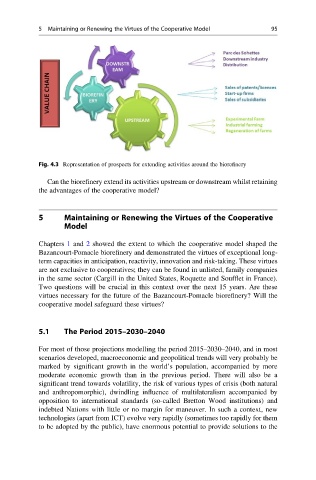
            Fig. 4.3 Representation of prospects for extending activities around the biorefinery

              Can the biorefinery extend its activities upstream or downstream whilst retaining
            the advantages of the cooperative model?


            5      Maintaining or Renewing the Virtues of the Cooperative
                   Model

            Chapters 1 and 2 showed the extent to which the cooperative model shaped the
            Bazancourt-Pomacle biorefinery and demonstrated the virtues of exceptional long-
            term capacities in anticipation, reactivity, innovation and risk-taking. These virtues
            are not exclusive to cooperatives; they can be found in unlisted, family companies
            in the same sector (Cargill in the United States, Roquette and Soufflet in France).
            Two questions will be crucial in this context over the next 15 years. Are these
            virtues necessary for the future of the Bazancourt-Pomacle biorefinery? Will the
            cooperative model safeguard these virtues?


            5.1    The Period 2015–2030–2040

            For most of those projections modelling the period 2015–2030–2040, and in most
            scenarios developed, macroeconomic and geopolitical trends will very probably be
            marked by significant growth in the world’s population, accompanied by more
            moderate economic growth than in the previous period. There will also be a
            significant trend towards volatility, the risk of various types of crisis (both natural
            and anthropomorphic), dwindling influence of multilateralism accompanied by
            opposition to international standards (so-called Bretton Wood institutions) and
            indebted Nations with little or no margin for maneuver. In such a context, new
            technologies (apart from ICT) evolve very rapidly (sometimes too rapidly for them
            to be adopted by the public), have enormous potential to provide solutions to the

