


Page 129 - Build Your Own Combat Robot
P. 129
Build Your Own Combat Robot
                 110
                                    where the force is being exerted. Equation 10 shows how the force is related to the
                                    applied torque.
                                                                                                    6.9

                                                                                                   6.10
                                      Using this relationship, you might think that your 500 in.-lb. torque motors and
                                    your 10-inch-diameter wheeled robot would have a pushing force of 100 pounds
                                    (100 pounds = 500 in.-ibs. / 5-inch radius). But this isn’t the case. Wheel friction
                                    becomes part of the equation. Without friction, powered wheels will never move a
                                    vehicle, and turning the vehicle would be virtually impossible. In most mechanical
                                    devices, friction is undesirable; but for wheels, friction is good. For combat ro-
                                    bots, the more friction you can get the better your robot can push. The frictional
                                    force to move an object across a horizontal floor is equal to the product of the co-
                                    efficient of friction between the floor and the object’s surface and the weight of the
                                    object. Equation 11 shows you how it works:
                                                                                                   6.11

                                    where F is the frictional force, µ is the coefficient of friction, and F is the weight of
                                           f                                            w
                                    the object.
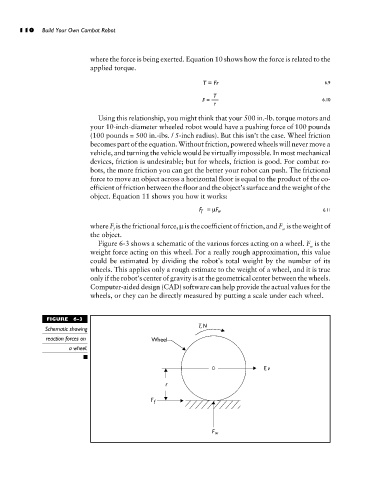
                                      Figure 6-3 shows a schematic of the various forces acting on a wheel. F is the
                                                                                                w
                                    weight force acting on this wheel. For a really rough approximation, this value
                                    could be estimated by dividing the robot’s total weight by the number of its
                                    wheels. This applies only a rough estimate to the weight of a wheel, and it is true
                                    only if the robot’s center of gravity is at the geometrical center between the wheels.
                                    Computer-aided design (CAD) software can help provide the actual values for the
                                    wheels, or they can be directly measured by putting a scale under each wheel.


                        FIGURE  6-3
                        Schematic showing
                        reaction forces on
                              a wheel.

