


Page 136 - Building A Succesful Board-Test Strategy
P. 136
122  BUILDING A SUCCESSFUL BOARD-TEST STRATEGY


 a board simulation—and metrology tools to establish pass/fail criteria. Some
 systems learn from a known-good board (subject to the usual caveats), and can
 automatically locate, inspect, and evaluate each solder connection. This approach
 involves training the system to recognize all of the solder-joint geometries that it
 must inspect and storing the information in a library with corresponding thresh-
 olds and tolerances. The engineer can modify the library criteria to allow for
 deviations and customizations.


    3.3.5.2  X-Ray Imaging
    X-ray inspection falls into two broad categories, covering two-dimensional
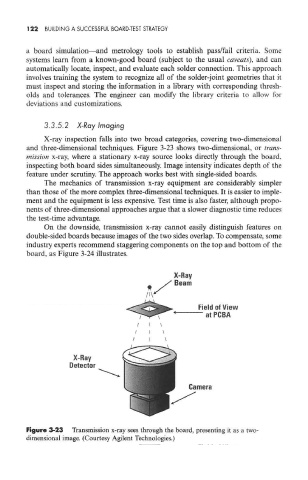
 and three-dimensional techniques. Figure 3-23 shows two-dimensional, or trans-
 mission x-ray, where a stationary x-ray source looks directly through the board,
 inspecting both board sides simultaneously. Image intensity indicates depth of the
 feature under scrutiny. The approach works best with single-sided boards.
    The mechanics of transmission x-ray equipment are considerably simpler
 than those of the more complex three-dimensional techniques. It is easier to imple-
 ment and the equipment is less expensive. Test time is also faster, although propo-
 nents of three-dimensional approaches argue that a slower diagnostic time reduces
 the test-time advantage.
    On the downside, transmission x-ray cannot easily distinguish features on
 double-sided boards because images of the two sides overlap. To compensate, some
 industry experts recommend staggering components on the top and bottom of the
 board, as Figure 3-24 illustrates.


 Figure 3-23  Transmission x-ray sees through the board, presenting it as a two-
 dimensional image. (Courtesy Agilent Technologies.)

