


Page 140 - Building A Succesful Board-Test Strategy
P. 140
126  BUILDING A SUCCESSFUL BOARD-TEST STRATEGY

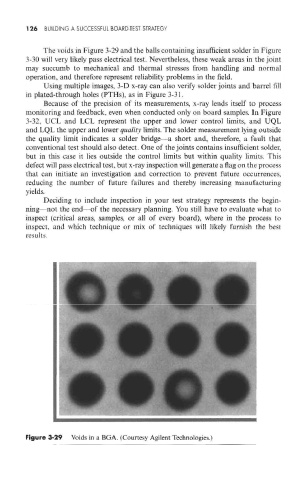
    The voids in Figure 3-29 and the balls containing insufficient solder in Figure
 3-30 will very likely pass electrical test. Nevertheless, these weak areas in the joint
 may succumb to mechanical and thermal stresses from handling and normal
 operation, and therefore represent reliability problems in the field.
    Using multiple images, 3-D x-ray can also verify solder joints and barrel fill
 in plated-through holes (PTHs), as in Figure 3-31.
     Because of the precision of its measurements, x-ray lends itself to process
 monitoring and feedback, even when conducted only on board samples. In Figure
 3-32, UCL and LCL represent the upper and lower control limits, and UQL
 and LQL the upper and lower quality limits. The solder measurement lying outside
 the quality limit indicates a solder bridge—a short and, therefore, a fault that
 conventional test should also detect. One of the joints contains insufficient solder,
 but in this case it lies outside the control limits but within quality limits. This
 detect will pass electrical test, but x-ray inspection will generate a flag on the process
 that can initiate an investigation and correction to prevent future occurrences,
 reducing the number of future failures and thereby increasing manufacturing
 yields.
     Deciding to include inspection in your test strategy represents the begin-
 ning— not the end—of the necessary planning. You still have to evaluate what to
 inspect (critical areas, samples, or all of every board), where in the process to
 inspect, and which technique or mix of techniques will likely furnish the best
 results.


 Figure 3-29  Voids in a EGA. (Courtesy Agilent Technologies.)

