


Page 302 - Buried Pipe Design
P. 302
Rigid Pipe Products  273

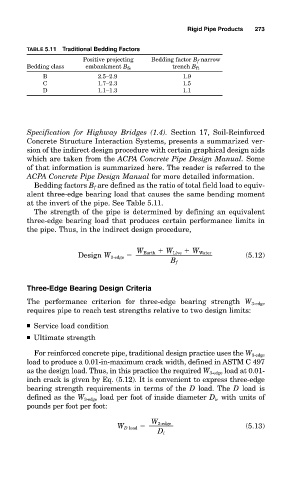
         TABLE 5.11 Traditional Bedding Factors
                         Positive projecting  Bedding factor B f narrow
         Bedding class   embankment B fe         trench B ft
              B              2.5–2.9                1.9
              C              1.7–2.3                1.5
              D              1.1–1.3                1.1


         Specification for Highway Bridges (1.4). Section 17, Soil-Reinforced
         Concrete Structure Interaction Systems, presents a summarized ver-
         sion of the indirect design procedure with certain graphical design aids
         which are taken from the ACPA Concrete Pipe Design Manual. Some
         of that information is summarized here. The reader is referred to the
         ACPA Concrete Pipe Design Manual for more detailed information.
           Bedding factors B f are defined as the ratio of total field load to equiv-
         alent three-edge bearing load that causes the same bending moment
         at the invert of the pipe. See Table 5.11.
           The strength of the pipe is determined by defining an equivalent
         three-edge bearing load that produces certain performance limits in
         the pipe. Thus, in the indirect design procedure,


                                       W Earth   W Live   W Water
                       Design W 3-edge                               (5.12)
                                                 B f


         Three-Edge Bearing Design Criteria

         The performance criterion for three-edge bearing strength  W 3-edge
         requires pipe to reach test strengths relative to two design limits:
         ■ Service load condition
         ■ Ultimate strength

           For reinforced concrete pipe, traditional design practice uses the W 3-edge
         load to produce a 0.01-in-maximum crack width, defined in ASTM C 497
         as the design load. Thus, in this practice the required W 3-edge load at 0.01-
         inch crack is given by Eq. (5.12). It is convenient to express three-edge
         bearing strength requirements in terms of the  D load. The  D load is
         defined as the W 3-edge load per foot of inside diameter D i , with units of
         pounds per foot per foot:

                                           W 3-edge
                                  W D load                           (5.13)
                                             D i

