


Page 212 - Cam Design Handbook
P. 212
THB7  8/15/03  1:58 PM  Page 200

          200                      CAM DESIGN HANDBOOK


                          1     È 3        T ˘    3         1
                                   ◊ )
                              ◊
                      I =  Ú  r r  (  r n 1 rn dS  =  ( n w 1 ) -  w n  T  (7.68)
                                        -
                                                      ◊
                       O
                       3i       Í    i     i  ˙  i   i  i      i  i
                          2  i S  5 Î       ˚    10         2
          with w i defined as:
                                     w ∫ ( r r rdS .                    (7.69)
                                            ◊ )
                                      i Ú
                                         S i     i
             The integral appearing in Eq. (7.69) is evaluated below. To this end, r is expressed as:
                                        r =+  p                         (7.70)
                                           r
                                           i
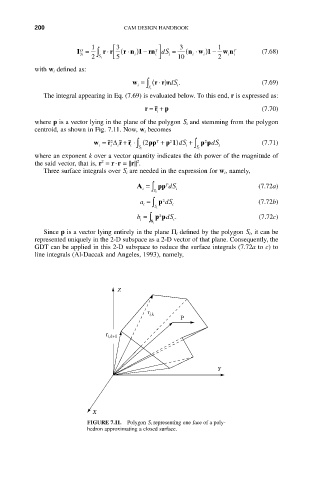
          where p is a vector lying in the plane of the polygon S i and stemming from the polygon
          centroid, as shown in Fig. 7.11. Now, w i becomes
                               2
                                  +
                                                        2
                                               2
                          w =  r D  r r ◊  (2 pp +  p 1 d ) S  +  p pdS  (7.71)
                                           T
                            i  i  i  i Ú S         i Ú S    i
                                       i               i
          where an exponent k over a vector quantity indicates the kth power of the magnitude of
                                      2
                            2
          the said vector, that is, r ∫ r·r =||r|| .
             Three surface integrals over S i are needed in the expression for w i, namely,
                                      A =   pp dS                      (7.72a)
                                              T
                                                 i
                                        i Ú S
                                           i
                                       a =  p 2 dS                     (7.72b)
                                        i Ú S   i
                                           i
                                      b =  pp dS .                     (7.72c)
                                            2
                                       i Ú S    i
                                          i
             Since p is a vector lying entirely in the plane P i defined by the polygon S i, it can be
          represented uniquely in the 2-D subspace as a 2-D vector of that plane. Consequently, the
          GDT can be applied in this 2-D subspace to reduce the surface integrals (7.72a to c) to
          line integrals (Al-Daccak and Angeles, 1993), namely,
                                 Z
                                         r i,k
                                                  P
                              r i,k+1
                                                            Y


                          X
                         FIGURE 7.11.  Polygon S i representing one face of a poly-
                         hedron approximating a closed surface.

