


Page 476 - Cam Design Handbook
P. 476
THB14  9/19/03  7:58 PM  Page 464

          464                      CAM DESIGN HANDBOOK

                                        E -
                                    y = (1 cos e) in.                   (14.9)
                                     e
          Differentiating, we find the velocity and acceleration
                                      ˙ y =  Ew  sine ips              (14.10)

                                   ˙˙ y =  Ew  2  cose in  sec .       (14.11)
                                                  2
             We see that the eccentric circle size has no effect on the follower action; only the eccen-
          tricity, E does. Furthermore, offsetting the line of follower motion from the cam center of
          rotation does not change the follower movement.


          14.7 CONTOUR-SHAPED RADIAL CAMS

          For  the  radial  cams  developed  elsewhere  in  this  book  the  desired  displacement
          characteristics are initially established and then the shape of the cam is mathematically
          determined. The analysis of the shape also includes the study of the geometric pressure
          angle  and  curvature  of  the  cam.  Then  the  cam-follower  dynamics  are  investigated  if
          necessary.
             In this section, we will establish the cam contours from known geometric shapes (some-
          times blended with other shapes) with limited control of the cam-follower system dynam-
          ics. These shapes are rarely utilized in design. In producing a radial cam we can apply any
          curve or combination of curves such as straight lines, circular arcs, Archimedes spirals,
          involute, logarithmic spirals, ellipses, parabolas, and hyperbolas. As cam-follower mech-
          anisms the curves can be utilized as partial or complete rotating bodies in contact with the
          follower.


          14.7.1 Special Contour
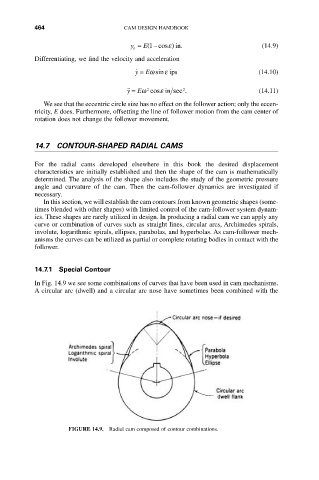
          In Fig. 14.9 we see some combinations of curves that have been used in cam mechanisms.
          A circular arc (dwell) and a circular arc nose have sometimes been combined with the


                    FIGURE 14.9.  Radial cam composed of contour combinations.

