


Page 544 - Cam Design Handbook
P. 544
THB16  9/19/03  8:04 PM  Page 532

          532                      CAM DESIGN HANDBOOK


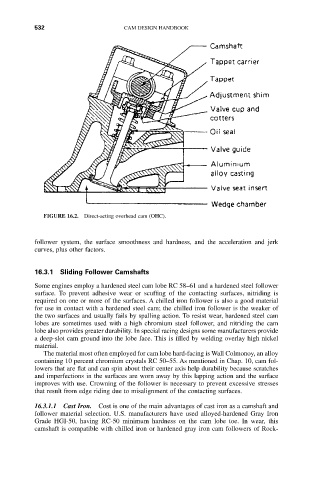
             FIGURE 16.2.  Direct-acting overhead cam (OHC).


          follower  system,  the  surface  smoothness  and  hardness,  and  the  acceleration  and  jerk
          curves, plus other factors.


          16.3.1 Sliding Follower Camshafts
          Some engines employ a hardened steel cam lobe RC 58–61 and a hardened steel follower
          surface.  To  prevent  adhesive  wear  or  scuffing  of  the  contacting  surfaces,  nitriding  is
          required on one or more of the surfaces. A chilled iron follower is also a good material
          for use in contact with a hardened steel cam; the chilled iron follower is the weaker of
          the two surfaces and usually fails by spalling action. To resist wear, hardened steel cam
          lobes  are  sometimes  used  with  a  high  chromium  steel  follower,  and  nitriding  the  cam
          lobe also provides greater durability. In special racing designs some manufacturers provide
          a deep-slot cam ground into the lobe face. This is filled by welding overlay high nickel
          material.
             The material most often employed for cam lobe hard-facing is Wall Colmonoy, an alloy
          containing 10 percent chromium crystals RC 50–55. As mentioned in Chap. 10, cam fol-
          lowers that are flat and can spin about their center axis help durability because scratches
          and imperfections in the surfaces are worn away by this lapping action and the surface
          improves with use. Crowning of the follower is necessary to prevent excessive stresses
          that result from edge riding due to misalignment of the contacting surfaces.
          16.3.1.1 Cast Iron.  Cost is one of the main advantages of cast iron as a camshaft and
          follower  material  selection.  U.S.  manufacturers  have  used  alloyed-hardened  Gray  Iron
          Grade  HGI-50,  having  RC-50  minimum  hardness  on  the  cam  lobe  toe.  In  wear,  this
          camshaft is compatible with chilled iron or hardened gray iron cam followers of Rock-

