


Page 548 - Cam Design Handbook
P. 548
THB16  9/19/03  8:04 PM  Page 536

          536                      CAM DESIGN HANDBOOK

          • Circular-arc—see Chap. 14
          • Circular-arc with straight line (tangent cam)—see Chap. 15
          • High-order polynomial curve
          • Composite cam designs
          • Polydyne cam (rarely used)
             The polynomial equation is the most popular method for blending the ramp and main
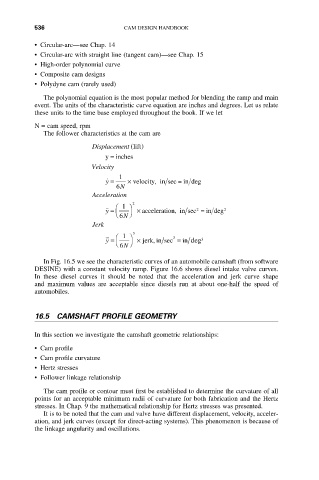
          event. The units of the characteristic curve equation are inches and degrees. Let us relate
          these units to the time base employed throughout the book. If we let
          N = cam speed, rpm
             The follower characteristics at the cam are
                                    (
                          Displacement lift)
                             y =  inches
                          Velocity
                                 1
                              ˙
                              y =  ¥  velocity, in sec = in deg
                                6 N
                          Acceleration
                                Ê 1  ˆ  2
                              ˙˙ y =  ¥  acceleration, in sec = in deg  2
                                                      2
                                Ë  6 N ¯
                          Jerk
                                Ê 1  ˆ  3       3
                              y =
                             ˙˙˙      ¥  jerk, in sec =  in deg 3
                                Ë  6 N  ¯
             In Fig. 16.5 we see the characteristic curves of an automobile camshaft (from software
          DESINE) with a constant velocity ramp. Figure 16.6 shows diesel intake valve curves.
          In  these  diesel  curves  it  should  be  noted  that  the  acceleration  and  jerk  curve  shape
          and  maximum  values  are  acceptable  since  diesels  run  at  about  one-half  the  speed  of
          automobiles.


          16.5 CAMSHAFT PROFILE GEOMETRY

          In this section we investigate the camshaft geometric relationships:
          • Cam profile
          • Cam profile curvature
          • Hertz stresses
          • Follower linkage relationship

             The cam profile or contour must first be established to determine the curvature of all
          points for an acceptable minimum radii of curvature for both fabrication and the Hertz
          stresses. In Chap. 9 the mathematical relationship for Hertz stresses was presented.
             It is to be noted that the cam and valve have different displacement, velocity, acceler-
          ation, and jerk curves (except for direct-acting systems). This phenomenon is because of
          the linkage angularity and oscillations.

