


Page 549 - Cam Design Handbook
P. 549
THB16  9/19/03  8:04 PM  Page 537

                                AUTOMOTIVE CAMSHAFT DYNAMICS               537


                                  Acceleration
                                       Velocity  Displacement
              Displacement (lift), Velocity, Acceleration, Jerk  Constant
                                                   (lift)


                    velocity


                                                                Closing Side
                                   Angle
               Opening Side
                                    40
               140 120 100  80  60  Jerk  20 NOSE  20  40  60  80  100  120 140
                    60  80  100  120  140 160  180 160 140  120 100  80  60
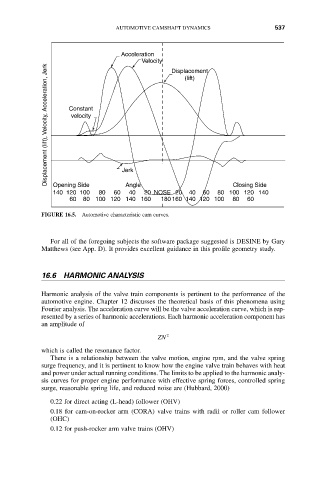
            FIGURE 16.5.  Automotive characteristic cam curves.

               For all of the foregoing subjects the software package suggested is DESINE by Gary
            Matthews (see App. D). It provides excellent guidance in this profile geometry study.


            16.6 HARMONIC ANALYSIS

            Harmonic analysis of the valve train components is pertinent to the performance of the
            automotive engine. Chapter 12 discusses the theoretical basis of this phenomena using
            Fourier analysis. The acceleration curve will be the valve acceleration curve, which is rep-
            resented by a series of harmonic accelerations. Each harmonic acceleration component has
            an amplitude of
                                            ZN  2

            which is called the resonance factor.
               There is a relationship between the valve motion, engine rpm, and the valve spring
            surge frequency, and it is pertinent to know how the engine valve train behaves with heat
            and power under actual running conditions. The limits to be applied to the harmonic analy-
            sis curves for proper engine performance with effective spring forces, controlled spring
            surge, reasonable spring life, and reduced noise are (Hubbard, 2000)
               0.22 for direct acting (L-head) follower (OHV)
               0.18  for  cam-on-rocker  arm  (CORA)  valve  trains  with  radii  or  roller  cam  follower
               (OHC)
               0.12 for push-rocker arm valve trains (OHV)

