


Page 552 - Cam Design Handbook
P. 552
THB16  9/19/03  8:04 PM  Page 540

          540                      CAM DESIGN HANDBOOK

             0.050

             0.045
             0.040
             0.035
            Thousandths inches  0.030


             0.025
             0.020
             0.015

             0.010
             0.005

                7000        7500       8000       8500        9000       9500
                                             APM
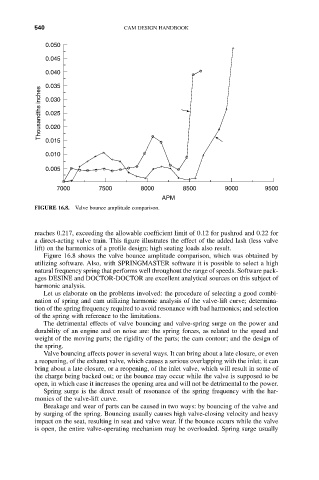
          FIGURE 16.8.  Valve bounce amplitude comparison.


          reaches 0.217, exceeding the allowable coefficient limit of 0.12 for pushrod and 0.22 for
          a direct-acting valve train. This figure illustrates the effect of the added lash (less valve
          lift) on the harmonics of a profile design; high seating loads also result.
             Figure 16.8 shows the valve bounce amplitude comparison, which was obtained by
          utilizing software. Also, with SPRINGMASTER software it is possible to select a high
          natural frequency spring that performs well throughout the range of speeds. Software pack-
          ages DESINE and DOCTOR-DOCTOR are excellent analytical sources on this subject of
          harmonic analysis.
             Let us elaborate on the problems involved: the procedure of selecting a good combi-
          nation of spring and cam utilizing harmonic analysis of the valve-lift curve; determina-
          tion of the spring frequency required to avoid resonance with bad harmonics; and selection
          of the spring with reference to the limitations.
             The detrimental effects of valve bouncing and valve-spring surge on the power and
          durability of an engine and on noise are: the spring forces, as related to the speed and
          weight of the moving parts; the rigidity of the parts; the cam contour; and the design of
          the spring.
             Valve bouncing affects power in several ways. It can bring about a late closure, or even
          a reopening, of the exhaust valve, which causes a serious overlapping with the inlet; it can
          bring about a late closure, or a reopening, of the inlet valve, which will result in some of
          the charge being backed out; or the bounce may occur while the valve is supposed to be
          open, in which case it increases the opening area and will not be detrimental to the power.
             Spring surge is the direct result of resonance of the spring frequency with the har-
          monics of the valve-lift curve.
             Breakage and wear of parts can be caused in two ways: by bouncing of the valve and
          by surging of the spring. Bouncing usually causes high valve-closing velocity and heavy
          impact on the seat, resulting in seat and valve wear. If the bounce occurs while the valve
          is open, the entire valve-operating mechanism may be overloaded. Spring surge usually

