


Page 158 - Catalysts for Fine Chemical Synthesis Vol 1 - Robert & Poignant
P. 158
asymmetric reduction using nonmetallic catalysts         145

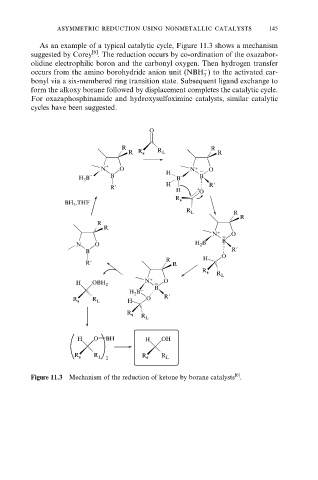
               As an example of a typical catalytic cycle, Figure 11.3 shows a mechanism
                             [6]
             suggested by Corey . The reduction occurs by co-ordination of the oxazabor-
             olidine electrophilic boron and the carbonyl oxygen. Then hydrogen transfer
             occurs from the amino borohydride anion unit (NBH ) to the activated car-
                                                            ÿ
                                                            3
             bonyl via a six-membered ring transition state. Subsequent ligand exchange to
             form the alkoxy borane followed by displacement completes the catalytic cycle.
             For oxazaphosphinamide and hydroxysulfoximine catalysts, similar catalytic
             cycles have been suggested.


                                             O

                                     R                        R
                                       R R s   R L             R
                                N +  O                  N +  −  O
                             −    B              H
                          H B                       B −    B
                           3
                                                 H           R9
                                  R9                      +
                                                    H     O
                                                    R s
                      BH 3 .THF
                                                                    R
                                                       R L
                                                                     R
                               R
                                 R
                                                              N +  −  O
                         N    O                          H 2 B   B
                            B                                      R9
                                                                O
                                                 R         H
                            R9                     R
                                                           R s
                                                               R L
                         H   OBH 2          N +  −  O
                                       H 2 B −  B
                                            O    R9
                                       H
                        R s  R L
                                       R s
                                           R L
                         H    O  BH         H   OH

                         R s  R L          R s  R L
                                 2
                                                                    [6]
             Figure 11.3 Mechanism of the reduction of ketone by borane catalysts .

