


Page 156 - Catalysts for Fine Chemical Synthesis Vol 1 - Robert & Poignant
P. 156
Catalysts for Fine Chemical Synthesis: Hydrolysis, Oxidation and Reduction. Volume 1
Edited by Stan M Roberts and Geraldine Poignant
Copyright 2002 John Wiley & Sons, Ltd.
ISBN: 0-471-98123-0
11 Asymmetric Reduction of Ketones
Using Nonmetallic Catalysts
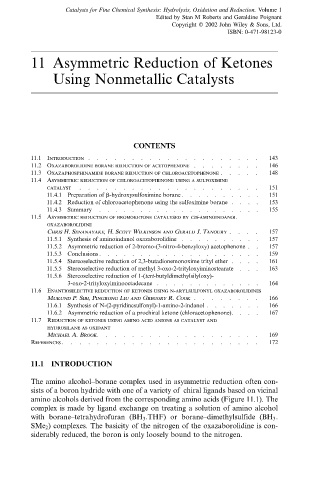
CONTENTS
11.1 Introduction . . . . . . . . . . . . . . . . . . . . 143
11.2 Oxazaborolidine borane reduction of acetophenone . . . . . . . . 146
11.3 Oxazaphosphinamide borane reduction of chloroacetophenone . . . . . 148
11.4 Asymmetric reduction of chloroacetophenone using a sulfoximine
catalyst . . . . . . . . . . . . . . . . . . . . . 151
11.4.1 Preparation of b-hydroxysulfoximine borane . . . . . . . . . . 151
11.4.2 Reduction of chloroacetophenone using the sulfoximine borane . . . . 153
11.4.3 Summary . . . . . . . . . . . . . . . . . . . . 155
11.5 Asymmetric reduction of bromoketone catalysed by cis-aminoindanol
oxazaborolidine
Chris H. Senanayake, H. Scott Wilkinson and Gerald J. Tanoury . . . . 157
11.5.1 Synthesis of aminoindanol oxazaborolidine . . . . . . . . . . 157
11.5.2 Asymmetric reduction of 2-bromo-(3-nitro-4-benzyloxy) acetophenone . . 157
11.5.3 Conclusions . . . . . . . . . . . . . . . . . . . . 159
11.5.4 Stereoselective reduction of 2,3-butadionemonoxime trityl ether . . . . 161
11.5.5 Stereoselective reduction of methyl 3-oxo-2-trityloxyiminostearate . . . 163
11.5.6 Stereoselective reduction of 1-(tert-butyldimethylsilyloxy)-
3-oxo-2-trityloxyiminooctadecane . . . . . . . . . . . . . 164
11.6 Enantioselective reduction of ketones using n-arylsulfonyl oxazaborolidines
Mukund P. Sibi, Pingrong Liu and Gregory R. Cook . . . . . . . . 166
11.6.1 Synthesis of N-(2-pyridinesulfonyl)-1-amino-2-indanol . . . . . . . 166
11.6.2 Asymmetric reduction of a prochiral ketone (chloracetophenone). . . . 167
11.7 Reduction of ketones using amino acid anions as catalyst and
hydrosilane as oxidant
Michael A. Brook. . . . . . . . . . . . . . . . . . . 169
References . . . . . . . . . . . . . . . . . . . . . . . 172
11.1 INTRODUCTION
The amino alcohol±borane complex used in asymmetric reduction often con-
sists of a boron hydride with one of a variety of chiral ligands based on vicinal
amino alcohols derived from the corresponding amino acids (Figure 11.1). The
complex is made by ligand exchange on treating a solution of amino alcohol
with borane±tetrahydrofuran (BH 3 :THF) or borane±dimethylsulfide (BH 3 :
SMe 2 ) complexes. The basicity of the nitrogen of the oxazaborolidine is con-
siderably reduced, the boron is only loosely bound to the nitrogen.

