


Page 168 - Catalysts for Fine Chemical Synthesis Vol 1 - Robert & Poignant
P. 168
asymmetric reduction using nonmetallic catalysts         155

                  1
                  H NMR(200 MHz, CDCl 3 ): d 7.39±7.31 (m, 5H, Ph); 4.88 (ddd, J 8.8 Hz,
               J 3.3 Hz, J 3.3 Hz, 1H, CH); 3.74 (dd, J 3.3 Hz, J 11.5 Hz, 1H, CH a H b ); 3.70
               (dd, J 8.8 Hz, J 11.8 Hz, 1H, CH a H b ); 2.78 (br s, 1H, OH).

             Conclusion

             To obtain a good enantiomeric excess, the ligand synthesis and the reduction
             reaction need to be carried out under strictly anhydrous conditions. The
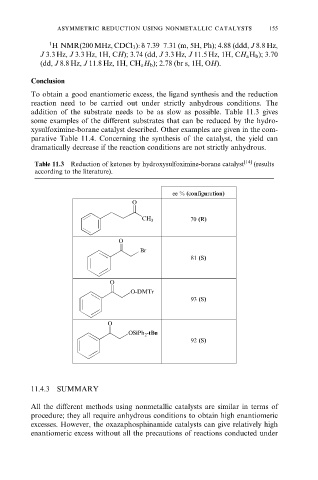
             addition of the substrate needs to be as slow as possible. Table 11.3 gives
             some examples of the different substrates that can be reduced by the hydro-
             xysulfoximine-borane catalyst described. Other examples are given in the com-
             parative Table 11.4. Concerning the synthesis of the catalyst, the yield can
             dramatically decrease if the reaction conditions are not strictly anhydrous.

              Table 11.3  Reduction of ketones by hydroxysulfoximine-borane catalyst [14]  (results
              according to the literature).

                                                   ee % (configuration)
                                        O

                                                        70 (R)
                                           CH 3
                                     O
                                          Br
                                                        81 (S)


                                  O
                                        O-DMTr
                                                        93 (S)


                                  O
                                       OSiPh 2 -tBu
                                                        92 (S)


             11.4.3  SUMMARY

             All the different methods using nonmetallic catalysts are similar in terms of
             procedure; they all require anhydrous conditions to obtain high enantiomeric
             excesses. However, the oxazaphosphinamide catalysts can give relatively high
             enantiomeric excess without all the precautions of reactions conducted under

