


Page 172 - Catalysts for Fine Chemical Synthesis Vol 1 - Robert & Poignant
P. 172
asymmetric reduction using nonmetallic catalysts         159

             . Magnetic stirrer
             . Buchner funnel

             Procedure
             1. 2-Bromo-(3-nitro-4-benzyloxyphenyl) ethanol (93 % ee, 48 g) and 100 mL of
               toluene were placed in a 500 mL flask. The mixture was warmed until all the
               alcohol dissolved. The mixture was cooled to 5 8C and stirred for 1 hour.
             2. Heptane (100 mL) was slowly added to the stirring mixture and that solution
               was stirred for 1 hour at 5 8C.
             3. The slurry was filtered and the solid washed with heptane (25 mL).
             4. The solid was dried in a vacuum oven to yield 45 g of 2-bromo-(3-nitro-4-
               benzyloxyphenyl) ethanol (>99 % ee).
                  1 H NMR (300 MHz DMSO-d6): d 7.88 (m, 1H), 7.65 (d, 1H), 7.3±7.5 (m,
               6 H), 6.01 (d, 1H), 5.35 (s, 2 H), 4.83 (m, 1H), 3.64 (ddd, 2H).
                  13 C NMR (MHz DMSO-d6): d 151.94, 140.15, 135.52, 133.24, 131.73,
               128.95, 128.51, 127.51, 123.62, 115.47, 72.40, 71.45, 39.75.
                  IR: (KBr): 3381 (OH), 3091, 3067, 2961, 2893 (C±H), 1532, 1296, 1026,
                     ÿ1
               729 cm .


             11.5.3  CONCLUSIONS

             This procedure has been developed through the evaluation of several reaction
             parameters (catalyst, temperature, borane source, additives) and has been
             successfully used on large scale. The chemical purity of the product is excellent
             and the enantiomeric purity of the product can be increased by crystallizing
             from toluene/heptane.
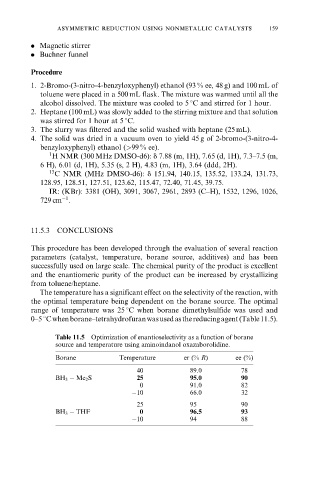
               The temperature has a significant effect on the selectivity of the reaction, with
             the optimal temperature being dependent on the borane source. The optimal
             range of temperature was 25 8C when borane±dimethylsulfide was used and
             0±5 8Cwhenborane±tetrahydrofuranwasusedasthereducingagent(Table11.5).

                   Table 11.5 Optimization of enantioselectivity as a function of borane
                   source and temperature using aminoindanol oxazaborolidine.
                   Borane            Temperature      er (% R)      ee (%)
                                         40             89.0          78
                   BH 3 ÿ Me 2 S         25             95.0          90
                                          0             91.0          82
                                        ÿ10             66.0          32
                                         25             95            90
                   BH 3 ÿ THF             0             96.5          93
                                        ÿ10             94            88

