


Page 174 - Catalysts for Fine Chemical Synthesis Vol 1 - Robert & Poignant
P. 174
asymmetric reduction using nonmetallic catalysts         161

             ketones. The highest selectivities are observed with catalyst 5a (tetralin plat-
             form) and catalyst 2b, and the lowest with catalysts 6a and 6b. From a practical
             point of view, B±H catalyst systems are much more preferred than B±alkyl
             systems. Therefore, the use of highly effective B±H oxazaborolidine catalysts
             from readily accessible tetralin and aminoindanol is recommended.


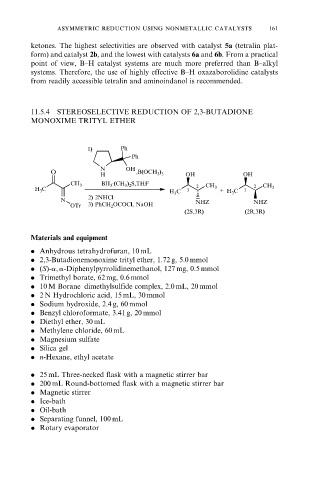
             11.5.4  STEREOSELECTIVE REDUCTION OF 2,3-BUTADIONE
             MONOXIME TRITYL ETHER


                            1)       Ph
                                        Ph
                                N      OH
                  O             H        ,B(OCH 3 ) 3  OH             OH
                        CH 3    BH 3 ·(CH 3 ) 2 S,THF     2  CH 3        2  CH 3
              H 3 C
                                                  H 3 C  3      +  H 3 C  3
                            2) 2NHCl
                     N                                   NHZ             NHZ
                       OTr  3) PhCH 2 OCOCl, NaOH
                                                      (2S,3R)          (2R,3R)

             Materials and equipment
             . Anhydrous tetrahydrofuran, 10 mL
             . 2,3-Butadionemonoxime trityl ether, 1.72 g, 5.0 mmol
             . (S)-a, a-Diphenylpyrrolidinemethanol, 127 mg, 0.5 mmol
             . Trimethyl borate, 62 mg, 0.6 mmol
             . 10 M Borane±dimethylsulfide complex, 2.0 mL, 20 mmol
             . 2 N Hydrochloric acid, 15 mL, 30 mmol
             . Sodium hydroxide, 2.4 g, 60 mmol
             . Benzyl chloroformate, 3.41 g, 20 mmol
             . Diethyl ether, 30 mL
             . Methylene chloride, 60 mL
             . Magnesium sulfate
             . Silica gel
             . n-Hexane, ethyl acetate

             . 25 mL Three-necked flask with a magnetic stirrer bar
             . 200 mL Round-bottomed flask with a magnetic stirrer bar
             . Magnetic stirrer
             . Ice-bath
             . Oil-bath
             . Separating funnel, 100 mL
             . Rotary evaporator

