


Page 179 - Catalysts for Fine Chemical Synthesis Vol 1 - Robert & Poignant
P. 179
166            hydrolysis, oxidation and reduction

                  2H), 4.02±4.18 (m, 2H), 7.10 (brd, 1H), 7.42±7.56 (m, 3H), 7.82 (d, J 6.7 Hz,
                  2H).


               11.6  ENANTIOSELECTIVE REDUCTION OF KETONES USING N-
               ARYLSULFONYL OXAZABOROLIDINES

               Mukund P. Sibi, Pingrong Liu, and Gregory R. Cook

               Center for Main Group Chemistry, Department of Chemistry, North Dakota State Uni-
               versity, Fargo ND, 58105±5516, Sibi@plains.nodak.edu, grcook@plains.nodak.edu


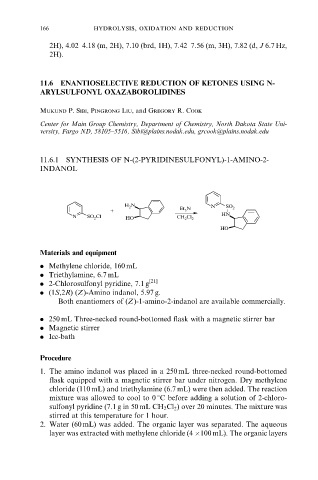
               11.6.1  SYNTHESIS OF N-(2-PYRIDINESULFONYL)-1-AMINO-2-
               INDANOL


                                      H 2 N                   N   SO 2
                                  +                  Et 3 N
                        N   SO 2 Cl   HO            CH 2 Cl 2   HN
                                                                HO


               Materials and equipment
               . Methylene chloride, 160 mL
               . Triethylamine, 6.7 mL
               . 2-Chlorosulfonyl pyridine, 7.1 g [21]
               . (1S,2R) (Z)-Amino indanol, 5.97 g.
                    Both enantiomers of (Z)-1-amino-2-indanol are available commercially.


               . 250 mL Three-necked round-bottomed flask with a magnetic stirrer bar
               . Magnetic stirrer
               . Ice-bath


               Procedure
               1. The amino indanol was placed in a 250 mL three-necked round-bottomed
                  flask equipped with a magnetic stirrer bar under nitrogen. Dry methylene
                  chloride (110 mL) and triethylamine (6.7 mL) were then added. The reaction
                  mixture was allowed to cool to 0 8C before adding a solution of 2-chloro-
                  sulfonyl pyridine (7.1 g in 50 mL CH 2 Cl 2 ) over 20 minutes. The mixture was
                  stirred at this temperature for 1 hour.
               2. Water (60 mL) was added. The organic layer was separated. The aqueous
                  layer was extracted with methylene chloride (4  100 mL). The organic layers

