


Page 181 - Catalysts for Fine Chemical Synthesis Vol 1 - Robert & Poignant
P. 181
168            hydrolysis, oxidation and reduction

               Procedure

               1. The ligand (191.4 mg) was placed in a 100 mL round-bottomed flask
                  equipped with a magnetic stirrer bar in an oil-bath at 40 8C, under nitrogen.
                  Dry tetrahydofuran (66 mL) was then added. After the solution turned clear,
                  borane±methyl sulfide complex (1.32 mL) was added dropwise. The mixture
                  was stirred at this temperature for 2.5 hours.
               2. Borane±methyl sulfide complex (3.3 mL) was added to the reaction mixture.
                  After stirring for an additional 1.5 hour at 40 8C, a solution of 2-chloroace-
                  tophenone (1.02 g in 5 mL of THF) was added over 2 hours using a syringe
                  pump. The reaction was monitored by TLC and after completion (1.5 hour),
                  it was cooled to 0 8C and quenched carefully with methanol. Solvent was
                  removed on a rotary evaporator. 1 M HCl (15 mL) was added followed by
                  extraction with dichloromethane (3   50 mL). The organic layers were com-
                  bined and washed with brine, dried over magnesium sulfate, and concen-
                  trated to give a liquid.
               3. The crude reaction mixture was purified by flash column chromatography
                  (10 % ethyl acetate in hexane) to give the product as a colourless liquid
                  (0.9 g, 90 % yield).
                  . The ee (86±89 %) was determined by HPLC (Chiralcel OD column, flow
                    rate 1 mL/min, eluent i-propanol±n-hexane 2:98), S-enantiomer: R t
                    22.2 min, R-enantiomer: R t 26.1 min.
                  .  1 H NMR (400 MHz, CDCl 3 ): d 7.4±7.3 (m, 5H), 4.89 (dd, J 13.2, 5.4 Hz,
                    1H), 3.8±3.6 (m, 2H), 2.62 (broad, 1H).
                  .  13 C NMR (100 MHz, CDCl 3 ): d 140.0, 128.8, 128.6, 126.2, 74.2, 51.0.


               Conclusions
               Oxazaborolidine-mediated reduction of ketones is very popular for the synthe-
               sis of enantiomerically pure secondary alcohols [22] . The present work illustrates
               an example of delivery of the hydride by borane coordinated to a remote Lewis
               basic site. The procedure is easy to reproduce. Slow addition of the ketone helps
               increase the enantioselectivity. The methodology is general and a variety of
               ketones can be reduced in high chemical yield and good enantioselectivity. The
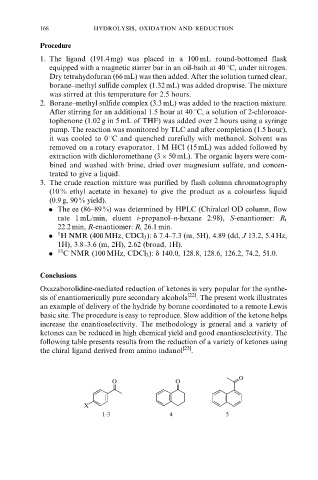
               following table presents results from the reduction of a variety of ketones using
               the chiral ligand derived from amino indanol [23] .


                                                                     O
                                   O                O

                           X
                                1-3               4               5

