


Page 182 - Catalysts for Fine Chemical Synthesis Vol 1 - Robert & Poignant
P. 182
asymmetric reduction using nonmetallic catalysts         169

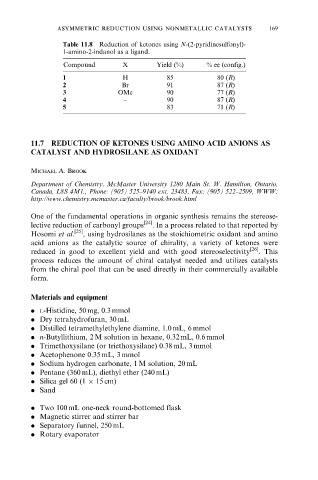
                     Table 11.8 Reduction of ketones using N-(2-pyridinesulfonyl)-
                     1-amino-2-indanol as a ligand.

                      Compound        X        Yield (%)    % ee (config.)
                     1                H           85           80 (R)
                     2               Br           91           87 (R)
                     3              OMe           90           77 (R)
                     4                ±           90           87 (R)
                     5                ±           83           71 (R)


             11.7  REDUCTION OF KETONES USING AMINO ACID ANIONS AS
             CATALYST AND HYDROSILANE AS OXIDANT

             Michael A. Brook

             Department of Chemistry, McMaster University 1280 Main St. W. Hamilton, Ontario,
             Canada, L8S 4M1., Phone: (905) 525±9140 ext. 23483, Fax: (905) 522±2509, WWW:
             http://www.chemistry.mcmaster.ca/faculty/brook/brook.html

             One of the fundamental operations in organic synthesis remains the stereose-
             lective reduction of carbonyl groups [24] . In a process related to that reported by
             Hosomi et al. [25] , using hydrosilanes as the stoichiometric oxidant and amino
             acid anions as the catalytic source of chirality, a variety of ketones were
             reduced in good to excellent yield and with good stereoselectivity [26] . This
             process reduces the amount of chiral catalyst needed and utilizes catalysts
             from the chiral pool that can be used directly in their commercially available
             form.

             Materials and equipment
             . l-Histidine, 50 mg, 0.3 mmol
             . Dry tetrahydrofuran, 30 mL
             . Distilled tetramethylethylene diamine, 1.0 mL, 6 mmol
             . n-Butyllithium, 2 M solution in hexane, 0.32 mL, 0.6 mmol
             . Trimethoxysilane (or triethoxysilane) 0.38 mL, 3 mmol
             . Acetophenone 0.35 mL, 3 mmol
             . Sodium hydrogen carbonate, 1 M solution, 20 mL
             . Pentane (360 mL), diethyl ether (240 mL)
             . Silica gel 60 (1   15 cm)
             . Sand
             . Two 100 mL one-neck round-bottomed flask
             . Magnetic stirrer and stirrer bar
             . Separatory funnel, 250 mL
             . Rotary evaporator

