


Page 105 - Chemical and process design handbook
P. 105
Speight_Part II_A  11/7/01  3:16 PM  Page 2.46


                            ALUMINUM SULFATE


                  Aluminum sulfate [Al (SO ) , alum, filter alum, papermaker’s alum] is
                                      2   4 3
                  manufactured from aluminum oxide (Al O , alumina, bauxite). A mixture
                                                     2  3
                                                                     o
                  of the crude ore and sulfuric acid is heated at 105 to 110 C for 15 to 20
                  hours.
                                   .
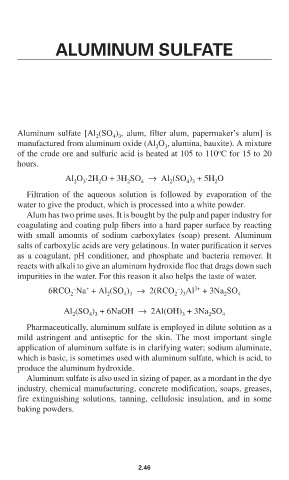
                              Al O 2H O + 3H SO → Al (SO ) + 5H O
                                2  3   2      2   4      2   4 3    2
                    Filtration of the aqueous solution is followed by evaporation of the
                  water to give the product, which is processed into a white powder.
                    Alum has two prime uses. It is bought by the pulp and paper industry for
                  coagulating and coating pulp fibers into a hard paper surface by reacting
                  with small amounts of sodium carboxylates (soap) present. Aluminum
                  salts of carboxylic acids are very gelatinous. In water purification it serves
                  as a coagulant, pH conditioner, and phosphate and bacteria remover. It
                  reacts with alkali to give an aluminum hydroxide floc that drags down such
                  impurities in the water. For this reason it also helps the taste of water.
                                –
                                                           –
                                    +
                                                               3+
                          6RCO Na + Al (SO ) → 2(RCO ) Al + 3Na SO
                                2        2   4 3          2  3         2  4
                              Al (SO ) + 6NaOH  → 2Al(OH) + 3Na SO
                                2   4 3                     3      2  4
                    Pharmaceutically, aluminum sulfate is employed in dilute solution as a
                  mild astringent and antiseptic for the skin. The most important single
                  application of aluminum sulfate is in clarifying water; sodium aluminate,
                  which is basic, is sometimes used with aluminum sulfate, which is acid, to
                  produce the aluminum hydroxide.
                    Aluminum sulfate is also used in sizing of paper, as a mordant in the dye
                  industry, chemical manufacturing, concrete modification, soaps, greases,
                  fire extinguishing solutions, tanning, cellulosic insulation, and in some
                  baking powders.


                                                 2.46

