


Page 136 - Circuit Analysis II with MATLAB Applications
P. 136
Chapter 4 The Laplace Transformation
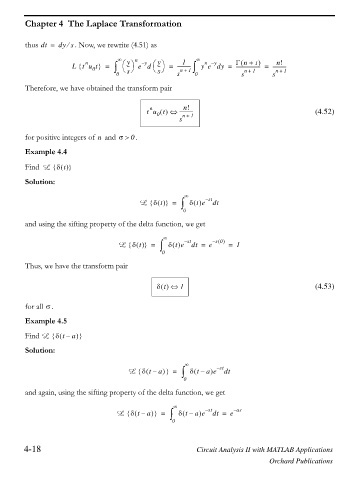
thus dt = dy s . Now, we rewrite (4.51) as
e
f n f
y
y
n §· y – §· 1 n – y * n + 1 n!
--
Lt u t^ 0 ` = ³ ©¹ e d -- s = ----------- 1³ y e dy = -------------------- = -----------
s
©¹
n +
n +
n +
0 s 0 s 1 s 1
Therefore, we have obtained the transform pair
n n!
t u t ----------- (4.52)
0
s n + 1
n
for positive integers of and V ! . 0
Example 4.4
Find L G t ^ `
Solution:
f
L G t = ³ G t e – st dt
^
`
0
and using the sifting property of the delta function, we get
f
L G t = ³ G t e – st dt = e – s0 = 1
`
^
0
Thus, we have the transform pair
G t 1 (4.53)
for all .
V
Example 4.5
Find L G t – ^ a `
Solution:
f
L G t – a ` ³ G = t – a e – st dt
^
0
and again, using the sifting property of the delta function, we get
f
L G t – a ` ³ G = t – a e – st dt = e – as
^
0
4-18 Circuit Analysis II with MATLAB Applications
Orchard Publications

