


Page 135 - Circuit Analysis II with MATLAB Applications
P. 135
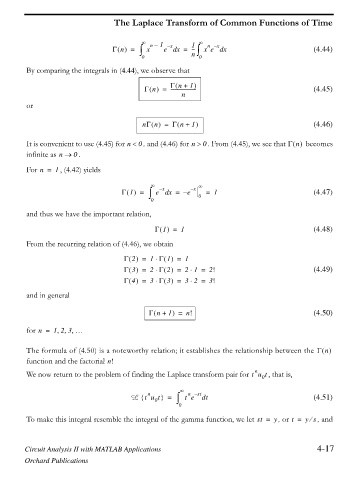
The Laplace Transform of Common Functions of Time
f – 1 f
x
n –
* n = ³ x n 1 – x x --- ³ x e d x (4.44)
e d =
0 n 0
By comparing the integrals in (4.44), we observe that
* n = * n + 1 (4.45)
---------------------
n
or
n* n = * n + 1 (4.46)
It is convenient to use (4.45) for n 0 , and (4.46) for n ! 0 . From (4.45), we see that * n becomes
infinite as n o . 0
For n = 1 , (4.42) yields
f f
x –
x
* 1 = ³ e d = e – x – 0 = 1 (4.47)
0
and thus we have the important relation,
* 1 = 1 (4.48)
From the recurring relation of (4.46), we obtain
* 2 = 1 * 1 = 1
* 3 = 2 * 2 = 21 = 2! (4.49)
* 4 = 3 * 3 = 32 = 3!
and in general
* n + 1 = n! (4.50)
for n = 1 2 3 }
The formula of (4.50) is a noteworthy relation; it establishes the relationship between the * n
function and the factorial n!
n
We now return to the problem of finding the Laplace transform pair for t u t , that is,
0
f
n n – st
L t u t^ 0 ` = ³ t e dt (4.51)
0
To make this integral resemble the integral of the gamma function, we let st = y , or t = y s , and
e
Circuit Analysis II with MATLAB Applications 4-17
Orchard Publications

