


Page 319 - Classification Parameter Estimation & State Estimation An Engg Approach Using MATLAB
P. 319
308                               STATE ESTIMATION IN PRACTICE


             5  z(i)
             4
             3
             2
             1
             0
            –1
            –2
            –3
            –4
            –5
              0    100   200   300   400   500   600   700   800   900   1000
                                                                       i

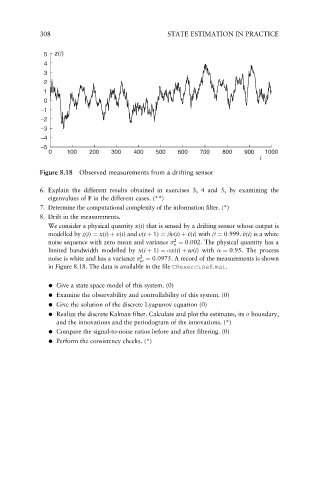
            Figure 8.18  Observed measurements from a drifting sensor

            6. Explain the different results obtained in exercises 3, 4 and 5, by examining the
              eigenvalues of F in the different cases. (**)
            7. Determine the computational complexity of the information filter. (*)
            8. Drift in the measurements.
              We consider a physical quantity x(i) that is sensed by a drifting sensor whose output is
                                                    v
                                                                   v
              modelled by z(i) ¼ x(i) þ v(i)and v(i þ 1) ¼  v(i) þ ~ v(i)with   ¼ 0:999. ~ v(i) is a white
                                                2
              noise sequence with zero mean and variance   ¼ 0:002. The physical quantity has a
                                                ~ v v
              limited bandwidth modelled by x(i þ 1) ¼  x(i) þ w(i)with   ¼ 0:95. The process
                                       2
              noise is white and has a variance   ¼ 0:0975. A record of the measurements is shown
                                       w
              in Figure 8.18. The data is available in the file C8exercise8:mat.
              . Give a state space model of this system. (0)
              . Examine the observability and controllability of this system. (0)
              . Give the solution of the discrete Lyapunov equation (0)
              . Realize the discrete Kalman filter. Calculate and plot the estimates, its   boundary,
                and the innovations and the periodogram of the innovations. (*)
              . Compare the signal-to-noise ratios before and after filtering. (0)
              . Perform the consistency checks. (*)

