


Page 322 - Classification Parameter Estimation & State Estimation An Engg Approach Using MATLAB
P. 322
BOSTON HOUSING CLASSIFICATION PROBLEM                        311

            ignore this problem, and we will assume that all features are real valued.
            (Obviously, we will lose some performance using this assumption.)


            9.1.2  Simple classification methods

            Given the varying nature of the different features, and the fact that further
            expert knowledge is not given, it will be difficult to construct a good model
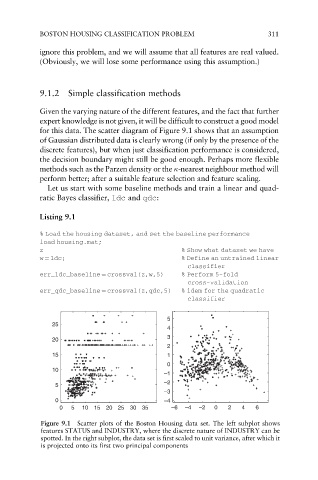
            for this data. The scatter diagram of Figure 9.1 shows that an assumption
            of Gaussian distributed data is clearly wrong (if only by the presence of the
            discrete features), but when just classification performance is considered,
            the decision boundary might still be good enough. Perhaps more flexible
            methods such as the Parzen density or the  -nearest neighbour method will
            perform better; after a suitable feature selection and feature scaling.
              Let us start with some baseline methods and train a linear and quad-
            ratic Bayes classifier, ldc and qdc:

            Listing 9.1

            % Load the housing dataset, and set the baseline performance
            load housing.mat;
            z                                     % Show what dataset we have
            w ¼ ldc;                              % Define an untrained linear
                                                    classifier
            err_ldc_baseline ¼ crossval(z,w,5)    % Perform 5-fold
                                                    cross-validation
            err_qdc_baseline ¼ crossval(z,qdc,5)  % idem for the quadratic
                                                    classifier

                                              5
               25
                                              4
                                              3
               20
                                              2
               15                             1
                                              0
               10
                                             –1
                                             –2
                5
                                             –3
                0                            –4
                 0  5  10  15  20 25  30  35   –6  –4  –2  0   2  4   6

            Figure 9.1 Scatter plots of the Boston Housing data set. The left subplot shows
            features STATUS and INDUSTRY, where the discrete nature of INDUSTRY can be
            spotted. In the right subplot, the data set is first scaled to unit variance, after which it
            is projected onto its first two principal components

