


Page 321 - Classification Parameter Estimation & State Estimation An Engg Approach Using MATLAB
P. 321
310                                      WORKED OUT EXAMPLES

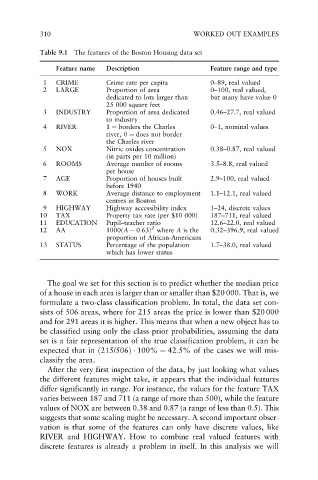
            Table 9.1 The features of the Boston Housing data set

                Feature name  Description                 Feature range and type

             1  CRIME         Crime rate per capita       0–89, real valued
             2  LARGE         Proportion of area          0–100, real valued,
                              dedicated to lots larger than  but many have value 0
                              25 000 square feet
             3  INDUSTRY      Proportion of area dedicated  0.46–27.7, real valued
                              to industry
             4  RIVER         1 ¼ borders the Charles     0–1, nominal values
                              river, 0 ¼ does not border
                              the Charles river
             5  NOX           Nitric oxides concentration  0.38–0.87, real valued
                              (in parts per 10 million)
             6  ROOMS         Average number of rooms     3.5–8.8, real valued
                              per house
             7  AGE           Proportion of houses built  2.9–100, real valued
                              before 1940
             8  WORK          Average distance to employment  1.1–12.1, real valued
                              centres in Boston
             9  HIGHWAY       Highway accessibility index  1–24, discrete values
            10  TAX           Property tax rate (per $10 000)  187–711, real valued
            11  EDUCATION     Pupil–teacher ratio         12.6–22.0, real valued
                                          2
            12  AA            1000ðA   0:63Þ where A is the  0.32–396.9, real valued
                              proportion of African-Americans
            13  STATUS        Percentage of the population  1.7–38.0, real valued
                              which has lower status


              The goal we set for this section is to predict whether the median price
            of a house in each area is larger than or smaller than $20 000. That is, we
            formulate a two-class classification problem. In total, the data set con-
            sists of 506 areas, where for 215 areas the price is lower than $20 000
            and for 291 areas it is higher. This means that when a new object has to
            be classified using only the class prior probabilities, assuming the data
            set is a fair representation of the true classification problem, it can be
            expected that in ð215/506Þ  100% ¼ 42:5% of the cases we will mis-
            classify the area.
              After the very first inspection of the data, by just looking what values
            the different features might take, it appears that the individual features
            differ significantly in range. For instance, the values for the feature TAX
            varies between 187 and 711 (a range of more than 500), while the feature
            values of NOX are between 0.38 and 0.87 (a range of less than 0.5). This
            suggests that some scaling might be necessary. A second important obser-
            vation is that some of the features can only have discrete values, like
            RIVER and HIGHWAY. How to combine real valued features with
            discrete features is already a problem in itself. In this analysis we will

