


Page 327 - Classification Parameter Estimation & State Estimation An Engg Approach Using MATLAB
P. 327
316                                      WORKED OUT EXAMPLES

            increase in error of about 0.005. Nevertheless, feature selection in gen-
            eral does not seem to help much for this data set.


            9.1.5  Complex classifiers

            The fact that ldc already performs so well on the original data indicates
            that the data is almost linearly separable. A visual inspection of the
            scatter plots in Figure 9.1 seems to strengthen this hypothesis. It becomes
            even more apparent after the training of a linear support vector classifier
            (svc([],‘p’,1)) and a Fisher classifier (fisherc), both with a cross-
            validation error of 13.0%, the same as for ldc.
              Given that ldc and parzenc thus far performed best, we might try
            to train a number of classifiers based on these concepts, for which we are
            able to tune classifier complexity. Two obvious choices for this are
            neural networks and support vector classifiers (SVCs). Starting with
            the latter, we can train SVCs with polynomial kernels of degree close
            to 1, and with radial basis kernels of radius close to 1. By varying the
            degree or radius, we can vary the resulting classifier’s nonlinearity:

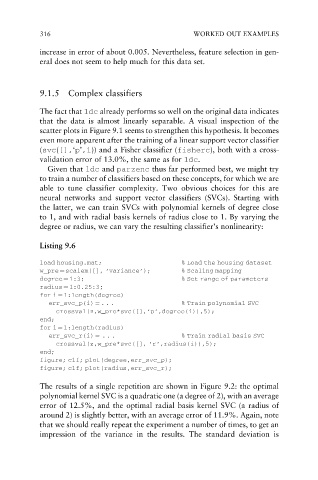
            Listing 9.6

            load housing.mat;                     % Load the housing dataset
            w_pre ¼ scalem([], ‘variance’);       % Scaling mapping
            degree ¼ 1:3;                         % Set range of parameters
            radius ¼ 1:0.25:3;
            for i ¼ 1:length(degree)
              err_svc_p(i) ¼ . . .                % Train polynomial SVC
                crossval(z,w_pre*svc([],‘p’,degree(i)),5);
            end;
            for i ¼ 1:length(radius)
              err_svc_r(i) ¼ . . .                % Train radial basis SVC
                crossval(z,w_pre*svc([], ‘r’,radius(i)),5);
            end;
            figure; clf; plot(degree,err_svc_p);
            figure; clf; plot(radius,err_svc_r);

            The results of a single repetition are shown in Figure 9.2: the optimal
            polynomial kernel SVC is a quadratic one (a degree of 2), with an average
            error of 12.5%, and the optimal radial basis kernel SVC (a radius of
            around 2) is slightly better, with an average error of 11.9%. Again, note
            that we should really repeat the experiment a number of times, to get an
            impression of the variance in the results. The standard deviation is

